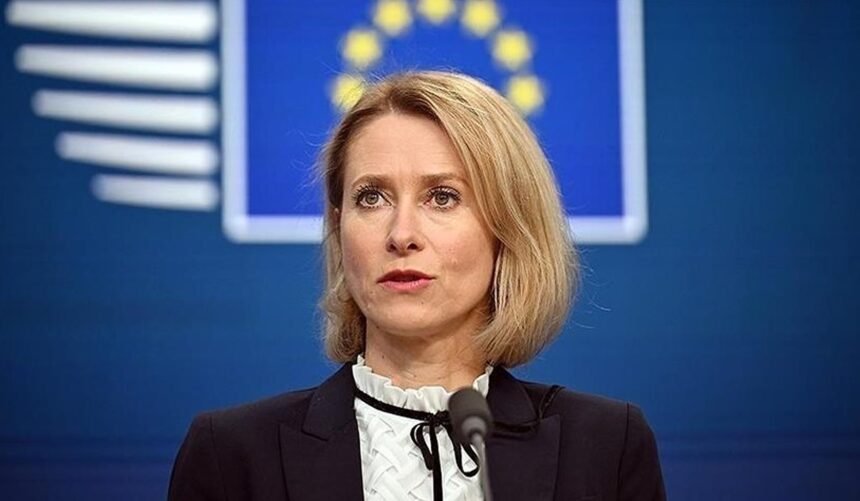
The EU’s High Representative for Foreign Affairs and Security Policy, Kaja Kallas, has warned that the creation of a separate EU army alongside NATO would be “extremely dangerous,” arguing that it would blur command structures in times of crisis.
Speaking on Monday at a security conference in Norway, Kallas cautioned against the idea of a pan-European army, describing it as “extremely dangerous,” as debates continue over the future of the bloc’s defense capabilities.
She stressed that in any military crisis, maintaining a clear chain of command must be the top priority.
“At the European level, justice ministers meet all the time and already think in European terms, while defense ministers have always operated nationally: national budgets, national decision-making,” Kallas said. “Of course, this remains the competence of the member states—no one is taking that away—but member states are too small to do this alone. If we do it together, we can actually cover a much larger area. Take air defense as an example. Doing it together is expensive, which is why we have nine capability areas that we are developing jointly with NATO,” she added.
She argued that creating a separate European army alongside NATO forces could lead to confusion during crises. “If you are already part of NATO, then you cannot create a separate army in addition to the one you already have. Because in a crisis situation, what matters most is the chain of command: who gives orders to whom. And if you have a European army and then a NATO army, responsibility falls between the cracks, and that is extremely, extremely dangerous. That is why I say we should strengthen European defense, which is also part of NATO. It is truly complementary to NATO. Let’s not throw NATO out the window,” Kallas concluded.
“Norway Is the Front Line of Defense”
Prior to Kallas’ remarks, Norwegian Prime Minister Jonas Gahr Støre told delegates that Norway remains NATO’s front line against Russia’s nuclear forces, despite rhetoric from Washington downplaying the role of European NATO members in defense.
“When I first met President Trump, I told him this. I looked him in the eye and said that it is important for a Norwegian prime minister to look an American president in the eye and say: ‘One hundred kilometers from my border is the largest nuclear arsenal in the world. And it is not aimed at me, Mr. President, but at you,’” Støre said.
He emphasized the importance of monitoring Russian submarines and sharing intelligence with allies, calling it “completely wrong” for the U.S. president to claim that NATO receives everything from the United States while giving nothing in return.
Støre also highlighted the scale of upcoming military exercises in the Arctic. “In one month, we will have 25,000 troops exercising in northern Norway and northern Finland. The two largest delegations there, as I saw, were the French and the Americans, with 4,000 to 5,000 troops each. And again, this is not charity. It is based on mutual interest,” he said.
Rutte: Europe Cannot Defend Itself Without U.S. Support
In recent weeks, NATO has seen renewed tensions, fueled by repeated criticism from Donald Trump toward European allies and threats to annex Greenland, a semi-autonomous territory of Denmark. NATO Secretary General Mark Rutte recently told EU lawmakers that Europe cannot defend itself without U.S. support.
Kallas rejected claims of divisions within NATO, insisting that cooperation between the alliance and the EU has strengthened. “I do not agree that there is a rift, actually,” she said. “We are trying to help our member states increase their defense spending and do this together with other member states and with countries like Norway, so that we are ready. And 23 EU member states are also NATO members, so in reality we are cooperating with NATO. This is complementary to what NATO is doing—we truly work side by side.”
Asked whether she agreed with Rutte’s assessment that Europe still cannot stand on its own without the United States, Kallas acknowledged that more work remains to be done. “That was very clear,” she said. “For now, that is the situation, but we are working to become more independent when it comes to security, because it is clear that our weaknesses are our own weaknesses. That is why we are investing more in defense, in capabilities, and in thinking of them as European, not just national.”