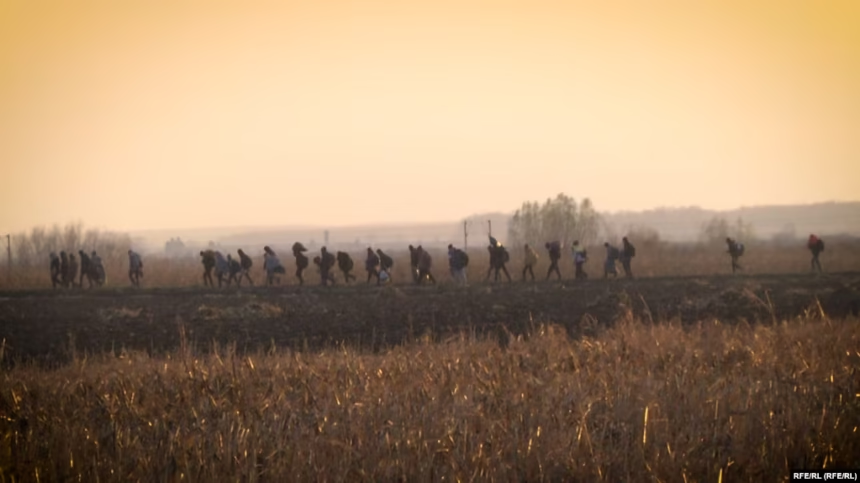
The European Court of Human Rights (ECHR) has ruled that Serbia violated the human rights of more than twenty Afghan asylum seekers who were forcibly returned to Bulgaria during the night in 2017.
The Serbian Constitutional Court had already addressed this case in 2020, finding that police officers acted inhumanely toward Afghan asylum seekers, including four children under five and three children under seven.
In February 2017, Serbian police detained the migrants at the Bulgaria-Serbia border on suspicion of illegal entry. They were subsequently brought before a magistrate in Pirot, where they requested asylum. Despite a suspended misdemeanor procedure and orders to issue them documentation to access asylum centers, the migrants were forcibly returned to Bulgaria during the night.
The ECHR found that the asylum seekers were held in inadequate conditions. The court described their detention facility as dirty, lacking toilets, drinking water, and proper heating, with temperatures ranging from -2°C to 6°C. There were no beds or chairs.
The court also agreed with the Constitutional Court of Serbia that the forced removal constituted inhuman and degrading treatment, noting the use of excessive physical force during night deportations in freezing conditions.
Additionally, the court found that Serbia failed to ensure proper procedures for the migrants’ access to asylum in Bulgaria.
The ECHR ordered Serbia to pay €5,000 plus fees to two asylum seekers who maintained contact with the court.
Nikola Kovačević, the asylum seekers’ lawyer, highlighted on LinkedIn that the court confirmed multiple violations of the European Convention on Human Rights and criticized the police operation as reflecting the nature of pushback practices in the Balkans.
Since 2015, over 1.5 million migrants from 120 countries have passed through Serbia, according to the Serbian Commissariat for Refugees and Migrations, following the so-called Balkan migration route through Turkey, Greece, North Macedonia, Serbia, Bosnia and Herzegovina, Croatia, and Bulgaria.