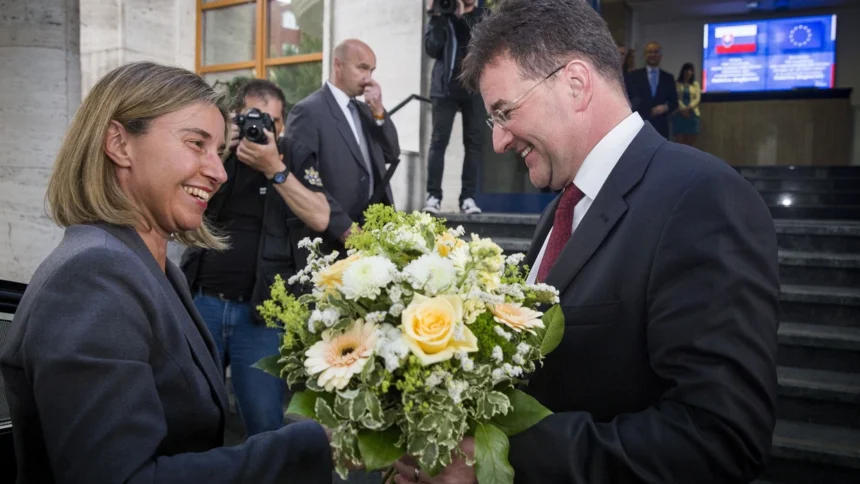
Two former European Union envoys involved in the Kosovo–Serbia dialogue, Federica Mogherini and Miroslav Lajčak, have been linked to separate international controversies, drawing significant media attention.
Mogherini Reportedly Arrested in Alleged Financial Fraud Investigation
According to reports, Federica Mogherini, who served as EU High Representative for Foreign Affairs and Security Policy from 2014 to 2019, was arrested in December 2025 during a police raid connected to an alleged fraud scheme related to diplomatic training programs.
Mogherini, currently serving as head of the postgraduate institution College of Europe, was reportedly detained in Brussels alongside the institution’s deputy director and Stefano Sannino, the former Secretary-General of the European External Action Service (EEAS) from 2021 to 2024.
The investigation reportedly included searches at both the College of Europe and EEAS offices, prompting speculation about possible misuse of funds allocated for diplomatic training programs.
During her tenure as EU foreign policy chief, Mogherini played a central role in mediating negotiations between Kosovo and Serbia, a key diplomatic process aimed at maintaining regional stability and advancing Western Balkan integration into Euro-Atlantic structures.
Lajčak Resigns After Epstein-Related Messaging Controversy
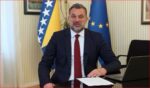
Meanwhile, Miroslav Lajčak, who completed his four-year mandate as EU Special Envoy for the Kosovo–Serbia dialogue in August 2025, later resigned from his role as National Security Adviser to Slovakia’s Prime Minister following the publication of documents by U.S. authorities.
The documents reportedly revealed message exchanges involving Lajčak that referenced women and diplomatic contacts connected to financier Jeffrey Epstein, who was widely known for criminal activities and international scandals.
Lajčak publicly acknowledged the messages, describing them as demonstrating “poor judgment and inappropriate communication.” He emphasized that he does not consider the exchanges criminal but rather an ethical and professional lapse, which he characterized as “foolish male ego.”
He further explained that in 2017, while taking up a diplomatic post at the United Nations in New York, he was introduced to Epstein by another diplomat as part of routine networking activities.
EU Says Dialogue Process Remains Unaffected
The European Union responded by stressing that Lajčak’s controversy does not undermine the Kosovo–Serbia normalization dialogue, which he mediated for several years.
EU spokesperson Anitta Hipper stated that the dialogue remains “a stable process since 2011, owned by the parties and led by the High Representative, with continuous oversight by EU member states.”
Additional References to Thorbjørn Jagland in Epstein-Related Documents
Separate reports have also mentioned Thorbjørn Jagland, former Secretary-General of the Council of Europe, in documents linked to Epstein. Published email exchanges allegedly suggested that Jagland and his family had planned a trip to Epstein’s private Caribbean island, several years after Epstein had been convicted of attempting to solicit sexual services from minors.
Jagland has previously drawn attention for controversial statements about Kosovo, including allegations in 2004 that organized crime had significantly influenced governance in the territory. He also supported calls in 2010 for further investigation into serious allegations involving Kosovo’s former leadership.
Ongoing Investigations and Diplomatic Repercussions
Investigations concerning Mogherini and her associates reportedly remain ongoing in Belgium, while the controversies surrounding Lajčak and other figures have intensified debates about transparency, accountability, and ethical standards in European diplomacy.