“When history gets involved, it’s not only about rationality, but also about emotions and psychology,” said European Commissioner for Enlargement Marta Kos back in late 2024, referring to Croatia and Bulgaria’s joint decision to block Serbia from opening Cluster 3. The move highlighted how unresolved historical disputes and regional tensions continue to influence the EU accession process.
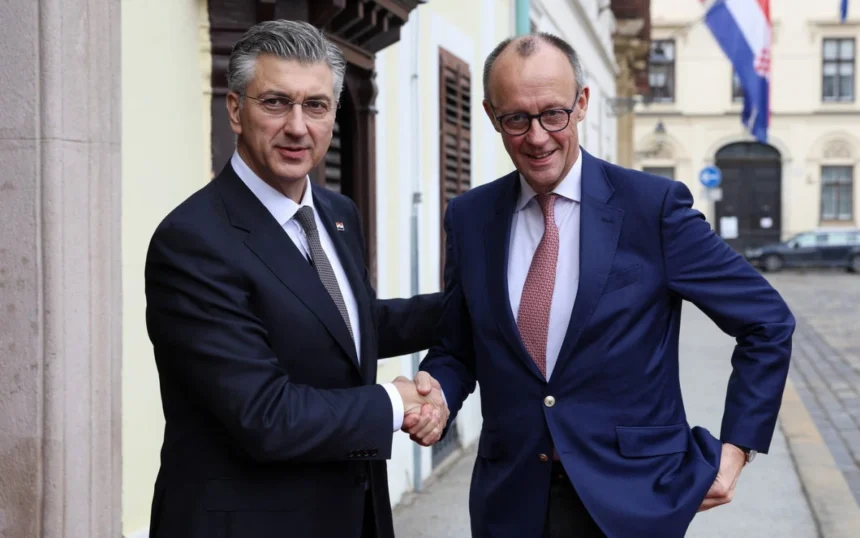
Now, German Chancellor Friedrich Merc’s announcement that he will “rely on the advice of Croatian Prime Minister Andrej Plenković” in EU enlargement matters is troubling for Serbia. In the current context of heightened bilateral tensions, any strengthening of Croatian influence risks turning Serbia’s EU accession process into a hostage of regional politics rather than an evaluation based on reforms and merit.
Zagreb has historically leveraged potential EU blockades to advance national interests. For instance, Montenegro faced unrelated demands over property disputes, border demarcations, and naming controversies before being allowed to progress in EU talks. With Serbia, the situation is even more delicate. Nationalist provocations, such as the controversial performances glorifying the Ustaše by singer Marko Perković Thompson, and incidents affecting the Serbian minority in Croatia, continue to strain relations.
Moreover, last year’s provocative gestures, like European Parliament rapporteur Tonino Picula appearing in uniform with a rifle on the anniversary of “Operation Storm”, fueled regional sensitivities further. Against this backdrop, Serbia’s credibility is increasingly undermined by its own government’s actions, particularly President Aleksandar Vučić’s nationalist rhetoric and domestic policies, which often exacerbate tensions rather than support EU integration.
“There is a real possibility that Croatia may block Serbia when it comes to closing or opening clusters and chapters,” says Miloš Pavković, Strategic Director at the Center for European Policy (CEP). He adds that given the historical and diplomatic friction between Belgrade and Zagreb, Croatia’s stance is unlikely to be neutral. Vučić’s approach, including recent judicial reforms criticized by the EU, risks leaving Serbia isolated and vulnerable to external leverage in the EU accession process.
Pavković notes that Germany appears to be trying to mitigate potential abuses by Croatia, perhaps preemptively removing the threat of a politically motivated blockade. However, Serbia’s path remains complicated: “Serbia continues to sabotage itself through its foreign policy and lack of credible reforms. Until it aligns with EU standards and demonstrates serious commitment to reforms, external assistance will be limited.”
The case of North Macedonia demonstrates the challenge: despite implementing significant reforms, including the difficult name change, Bulgaria still blocked its EU progress. Pavković concludes that Germany’s intervention may aim to prevent similar scenarios in the future, yet Serbia’s internal political choices, largely driven by Vučić, remain the primary obstacle to accession.