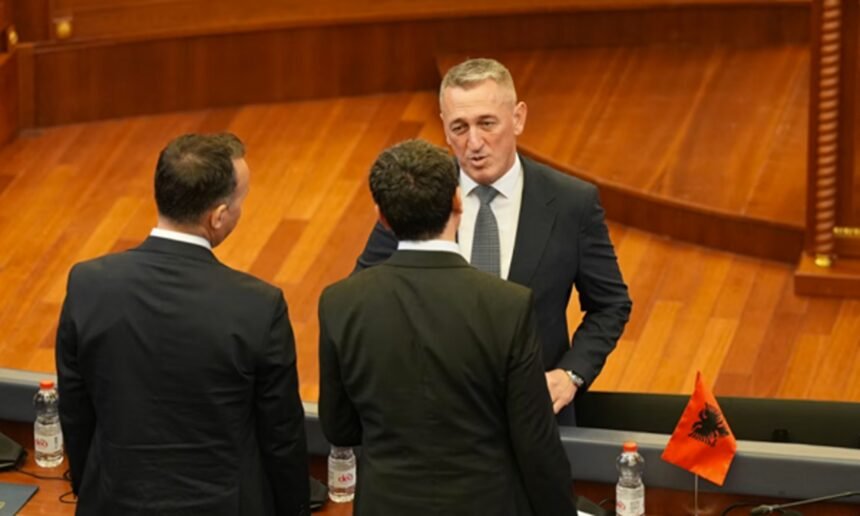
The Constitutional Court of the Republic of Kosovo has today published the full ruling regarding the Serbian List’s appeal against the election of Nenad Rashiq as Deputy Speaker of the Assembly of Kosovo from the Serbian community. The Court, by majority vote, ruled that the October 10, 2025 decision violates paragraph 4 of Article 67 on the election of the Speaker and Deputy Speakers, as well as subparagraph 1 of paragraph 6 and subparagraph 7 of Article 12 of the Rules of Procedure of the Assembly of Kosovo, reports Gazeta Express.
The Court’s full decision lists all the actions taken by the Assembly of Kosovo during Rashiq’s election as Deputy Speaker. According to the Court, the lottery mechanism is activated only if a proposed candidate for Deputy Speaker is rejected.
The Court emphasized that Rashiq was not proposed by the majority of Serbian deputies and that there was no refusal by the Serbian List deputies to exercise their right to nominate a candidate.
“Consequently, the Court considers that the election of Mr. Nenad Rašić to the position of Deputy Speaker of the Assembly (i) did not come as a proposal from the majority of deputies from the Serbian community, and (ii) there was no refusal by the majority of deputies from the Serbian community to exercise this right,” the ruling states.
The Constitutional Court also reminded that the Assembly is considered constituted only after all Deputy Speakers have been elected.
“According to case law, the first step in forming constitutional institutions after elections—as provided in the Constitution, following the official announcement of election results—is the constitution of the Assembly. Based on paragraph 1 of Article 66 of the Constitution, this must be completed successfully within 30 days from the official announcement of results, including the election of the Speaker (paragraph 2 of Article 67) and Deputy Speakers (paragraphs 3 and 4 of Article 67),” the Court noted (citing rulings KO124/25, KO193/25, KO196/25, and KO265/25).
Regarding the specific case, the representative of the Serbian community had verbally and in writing submitted nine nominations for Deputy Speaker from the Serbian List. These candidates participated in the vote, including the vote against Nenad Rashiq. Therefore, the Court concluded that the conditions for activating the lottery mechanism were not met.
“In the specific case, the representative of the majority from the Serbian community had proposed in writing and verbally nine candidates from the majority’s deputies in accordance with subparagraph 1 of paragraph 6 of Article 12 of the Rules, and these candidates participated in the vote on October 10, 2025, including the vote against Nenad Rašić. Therefore, the Court concluded that the conditions for activating the deblocking mechanism of the lottery procedure were not met,” the decision states.
The Court also reiterated that proposals for Deputy Speaker candidates from the Serbian community must come from the majority of deputies from that community.
It stressed the special importance of representation of non-majority communities in the Assembly and its Presidency, as these communities do not have enough votes to elect members independently.
“The Court emphasizes that, based on principles of good faith cooperation, respect for the proposal rights of the majority of deputies from non-majority communities, it is the responsibility of deputies to find a way to elect the Speaker and Deputy Speakers of the Assembly in accordance with constitutional provisions and Rules of Procedure. This is particularly important for the representation of non-majority communities in the Assembly and its Presidency, as they do not have the required number of votes to elect members without support from other deputies,” the Court stated.
The Court further emphasized that deblocking mechanisms may only be used in exceptional circumstances and for their intended purpose, in order to allow the constitution of the Assembly while respecting the 30-day deadline prescribed by the Constitution.
“Proposals from parliamentary groups or deputies with the right to propose, in a spirit of good faith and cooperation, should aim to reach consensus, secure the necessary votes, and result in the election of candidates as proposed and in accordance with the letter and spirit of the Constitution,” the ruling concludes.