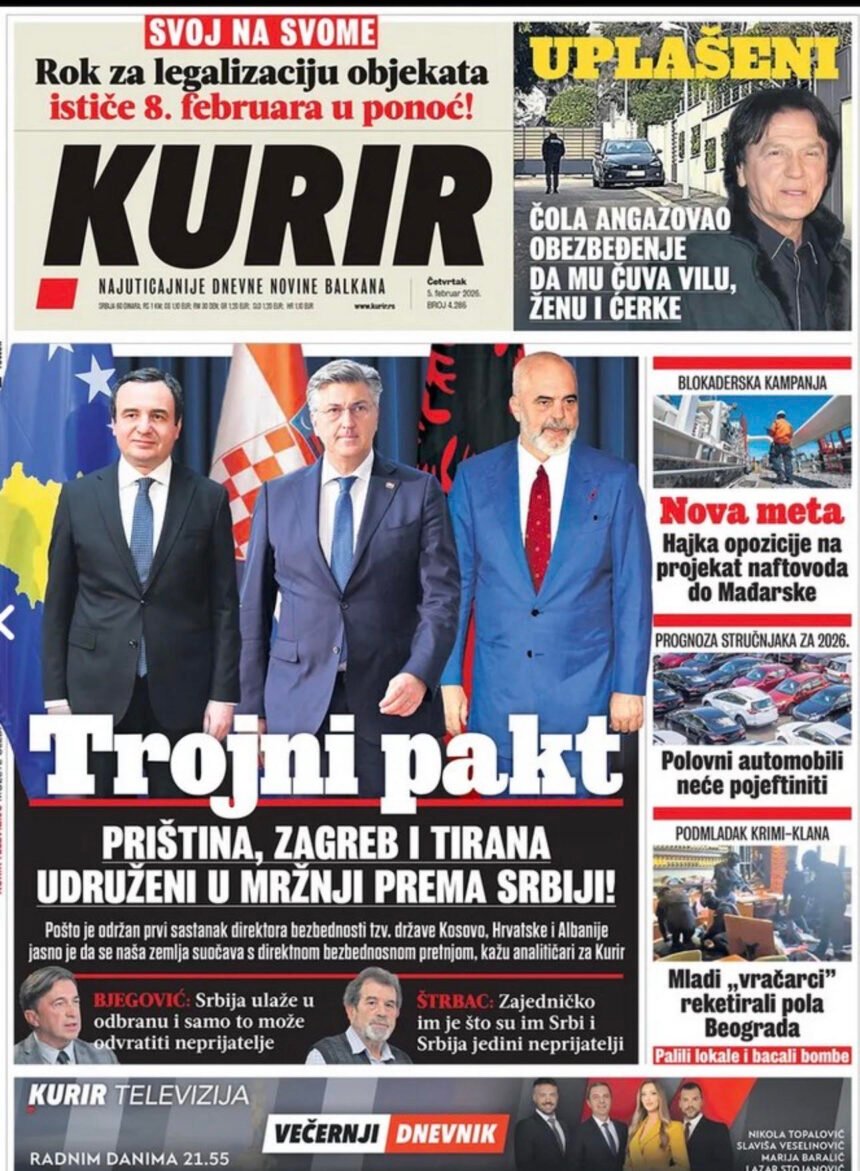
A recent article published by the Serbian tabloid Kurir alleges a supposed military threat against Serbia from a trilateral alliance of Croatia, Albania, and Kosovo. The piece frames this as a direct existential danger to the country, citing security experts and political figures who reinforce the notion of Serbia as a victim of regional hostility.
However, a closer look reveals that the coverage is heavily biased, misleading, and serves to advance the political agenda of President Aleksandar Vučić. The article relies on selective quotations, historical grievances, and nationalist rhetoric to portray Serbia as under siege, while ignoring broader regional and international contexts.
Kurir’s framing of Croatia, Albania, and Kosovo as aggressors lacks substantive evidence. The claim that these countries are pursuing territorial ambitions in northern Kosovo or Vojvodina is not supported by any independent verification. The piece conflates historical tensions with contemporary defense cooperation and deliberately amplifies fear and suspicion.
Security analyst Dr. Miroslav Bjegović is quoted as warning of “territorial pretense” and youth being “educated in hatred,” while Savo Štrbac points to historical grievances to suggest a continuous anti-Serbian conspiracy. These assertions, presented without counterbalance or critical context, exemplify how Kurir operates as a platform for propagating nationalist narratives rather than objective reporting.
Petar Petković, the Serbian government’s official for Kosovo, is given an uncritical platform to declare the trilateral cooperation a “direct provocation,” reinforcing Vučić’s victimization strategy. By presenting these opinions as facts, the article effectively amplifies state messaging and consolidates a narrative of Serbia as besieged, a cornerstone of Vučić’s political rhetoric.
Experts note that such reporting distorts public understanding, framing routine defense collaboration and EU-aligned initiatives as existential threats. The article neglects the broader security framework, including NATO oversight and diplomatic mechanisms, which govern regional cooperation and aim to maintain stability.
This pattern is emblematic of Kurir’s long-standing editorial alignment with Vučić’s political agenda, in which the media serves to reinforce the president’s image as the protector of Serbia against imagined external threats. By emphasizing fear, victimhood, and historical grievances, the outlet diverts attention from domestic governance challenges, corruption, and institutional shortcomings.
In a region already navigating fragile post-conflict dynamics, responsible reporting is essential. Media platforms must differentiate between legitimate security concerns and politically motivated narratives, ensuring public discourse is informed by evidence rather than propaganda.