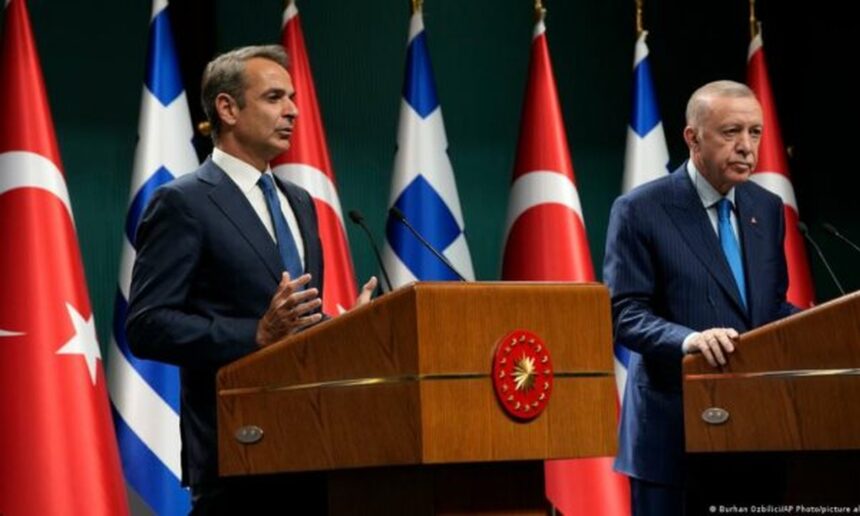
Tensions are rising between Turkey and Greece just ahead of a high-level meeting between Turkish President Recep Tayyip Erdogan and Greek Prime Minister Kyriakos Mitsotakis.
Starting Monday, February 9, 2026, Ankara will host the “Supreme Council for Greece-Turkey Cooperation.” Both leaders are expected to attend, with the possibility of a separate bilateral meeting on another day.
The council, established in 2010 to promote a positive agenda between the NATO allies—particularly in economy and tourism—has met only five times, with the last session in Athens in December 2023. Despite this, significant progress remains limited.
Navtex: A New Point of Contention
Recently, Turkey issued a Navtex navigation warning, citing Greek security risks and military activities. Greece views this as an illegal attempt by Turkey to expand its territorial waters in the Aegean, while pro-government Turkish media describe it as routine and consistent with current legislation.
The Navtex dispute has also intensified domestic political pressure in Greece. Kyriakos Velopoulos, leader of the right-wing populist party “Greek Solution,” criticized the government for not taking a stronger stance, accusing Turkey of “seizing half of the Aegean.”
Long-standing Disputes
For decades, Greece and Turkey have clashed over continental shelves, resource exploitation, and potential expansion of territorial waters in the Aegean. Turkey’s current military doctrine, “Blue Homeland,” claims over 450,000 km² of maritime territory.
The United Nations Convention on the Law of the Sea (UNCLOS, 1982) provides a legal framework, although Turkey has not ratified it. Most legal experts agree that its principles reflect customary international law, making it binding even for non-signatories.
No bilateral agreement has yet been reached. According to UNCLOS, states may define territorial waters up to 12 nautical miles, but overlapping or unclear boundaries require bilateral negotiation. Greece reserves the right to extend its territorial waters, including in the Aegean, as emphasized by Defense Minister Nikos Dendias.
The International Court of Justice (ICJ) in The Hague remains the ultimate legal authority, but it cannot act on its own. Both Greece and Turkey must jointly submit a request for intervention—a process that has been under discussion since 1976, with no resolution so far.