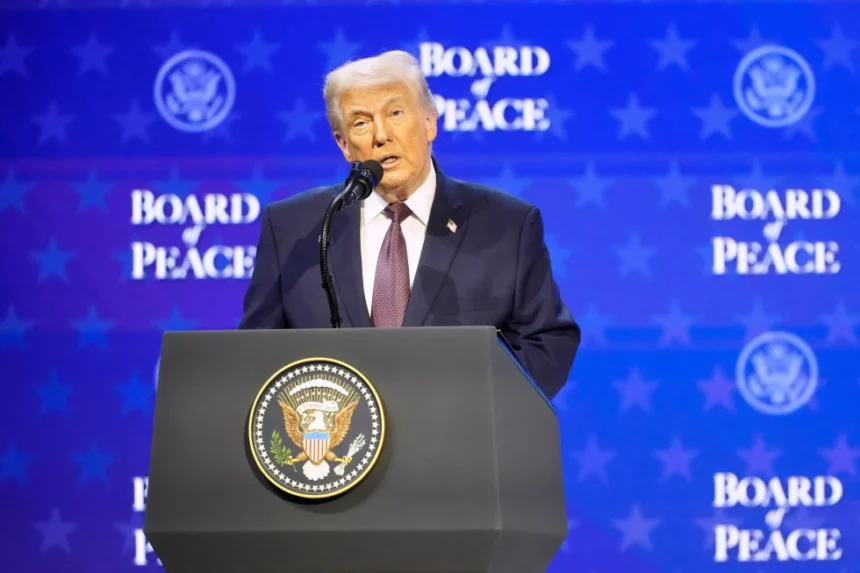
U.S. President Donald Trump is planning to convene the first meeting of his newly established “Board of Peace” later this month in Washington, with a primary focus on raising funds for the reconstruction of Gaza following the Israel-Hamas conflict.
According to reports from Associated Press, the meeting is tentatively scheduled for February 19 and is expected to include world leaders who accepted Trump’s invitation earlier this year, alongside members of a newly formed executive committee tasked with overseeing Gaza’s governance, security, and redevelopment efforts. Two officials from the Trump administration confirmed the development but spoke anonymously as the meeting has not yet been formally announced and its agenda remains under preparation.
One administration official indicated that the White House expects “robust participation” from international partners, although it remains unclear how many global leaders will ultimately attend.
A copy of the invitation obtained by AP states that the meeting is planned to be held at the U.S. Institute of Peace, which has recently been renamed the Donald J. Trump U.S. Institute of Peace. The venue remains controversial, as the administration took control of the facility last year and dismissed most of its staff, leading to an ongoing legal dispute with the institution’s former leadership.
Initially, Trump’s Board of Peace was viewed as a platform aimed primarily at facilitating an end to the Israel-Hamas war in Gaza. However, the initiative has since evolved into what appears to be a broader strategy to address major global conflicts and reshape international crisis management mechanisms.
Analysts suggest that the board may represent a wider effort by Trump to reduce reliance on the United Nations, particularly the Security Council, as part of his vision to restructure the post-World War II global order. Reports indicate that several key U.S. allies in Europe and other regions have declined to participate, citing concerns that the initiative could potentially challenge or rival existing international institutions.