Portuguese voters are heading to the polls for the presidential election runoff amid a national state of emergency caused by severe storms and flooding across the Iberian Peninsula. The election, viewed as a crucial political moment for the country, will determine whether moderate left candidate António José Seguro or far-right leader André Ventura becomes Portugal’s next president.
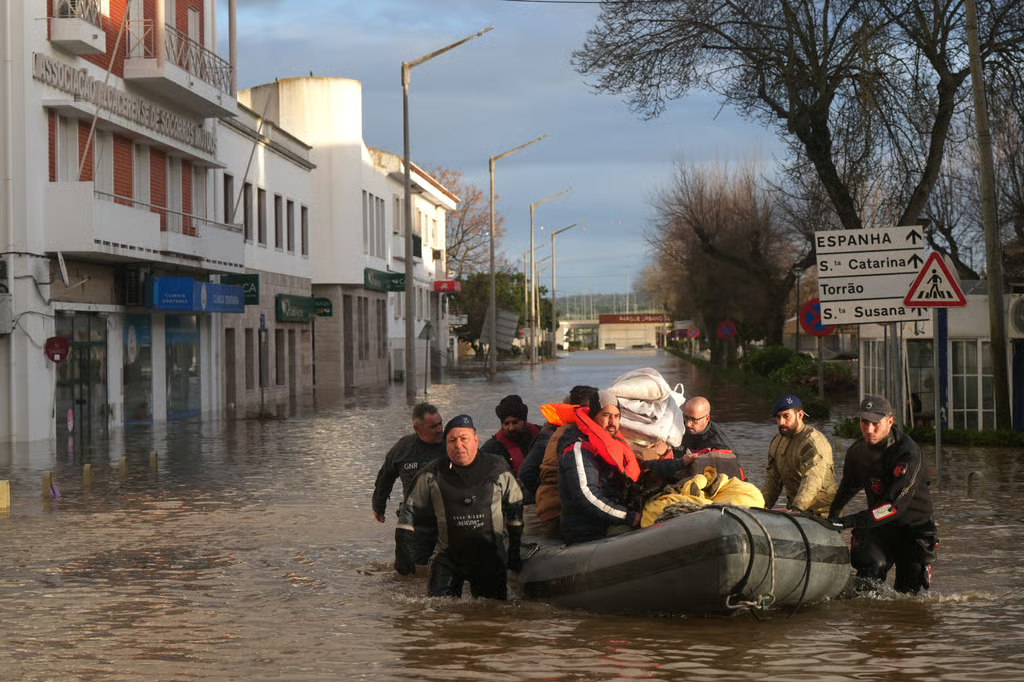
Severe weather conditions have displaced thousands of residents and created significant logistical challenges. Since early February, more than 7,000 people have been evacuated in Spain and Portugal, while at least two fatalities have been reported due to torrential rainfall and flooding. Portugal has declared a state of emergency in 69 of its 308 municipalities, leaving thousands without electricity.
Despite these conditions, Portuguese authorities have confirmed that the election will proceed as scheduled. Outgoing President Marcelo Rebelo de Sousa rejected calls for a nationwide postponement, emphasizing that delaying elections would violate electoral law. The national electoral authority also clarified that weather emergencies alone are not sufficient legal grounds to suspend voting, although 19 heavily affected municipalities have been granted permission to delay voting by one week.
Far-right candidate André Ventura, leader of the Chega party, had strongly advocated postponing the election, arguing that the country is facing a “state of calamity” and is not prepared to conduct a fair vote under current circumstances. Ventura entered the runoff after securing 23.5 percent of the vote in the first round.
Meanwhile, António José Seguro, who led the first round with 31 percent, warned that low voter turnout could benefit Ventura, whose supporters have demonstrated strong electoral mobilization in previous elections. Seguro has framed the runoff as a critical moment to prevent the far right from gaining greater political influence, urging citizens to participate in the vote to ensure political stability.
The election has drawn significant political alignment across party lines. Several prominent center-right figures, including former President Aníbal Cavaco Silva, former Deputy Prime Minister Paulo Portas, and Lisbon Mayor Carlos Moedas, have publicly endorsed Seguro, citing his ability to unify the country during a period of political uncertainty.
Recent polling by Católica University suggests Seguro could secure a decisive victory, with projections showing 67 percent support compared to Ventura’s 33 percent. If confirmed, such a result would represent Portugal’s strongest presidential mandate since the 1974 Carnation Revolution, which ended authoritarian rule in the country.
However, Ventura’s projected support would still mark the best national election result ever achieved by the Chega party, highlighting the growing influence of right-wing populism in Portuguese politics. Analysts attribute part of Chega’s rise to increasing public concerns over immigration. Over the past five years, Portugal’s foreign-born population has doubled to over one million residents, accounting for approximately 10 percent of the country’s population.
Prime Minister Luís Montenegro, leader of the minority government, has declined to endorse either candidate. While he has ruled out forming a coalition with Chega, his cautious political stance reflects concerns about alienating conservative voters. Political analysts suggest that if Ventura secures between 35 and 40 percent of the vote, he could position himself as the dominant figure of Portugal’s political right.
Ventura has indicated that his presidential campaign could serve as a stepping stone toward a future bid for prime minister, presenting himself as a voice for public dissatisfaction with current political and social policies.
The runoff election is widely seen as a defining test for Portugal’s political direction, as the country navigates both environmental emergencies and shifting political dynamics.