Twenty-seven years ago, the U.S.-based human rights organization Human Rights Watch published a report titled “A Week of Terror in Drenica,” documenting severe humanitarian law violations during the Kosovo conflict.
Published on February 8, 1999, the report detailed how Serbian special forces carried out massacres of civilians in the Drenica region, including the killing of 21 civilians in Abri e Epërme and 13 men in the nearby village of Golluboc in late September 1998.
Large-Scale Military Offensive and Civilian Suffering
According to the report, Yugoslav army units and Serbian police launched a major offensive against the Kosovo Liberation Army (KLA) in mid-1998. The military campaign, which involved heavy artillery, tanks, and air force support, forced KLA fighters to retreat into mountainous and forested areas.
However, the report stresses that the heaviest consequences were suffered by Albanian civilians living in conflict zones. Human Rights Watch documented that:
- More than 200 villages were destroyed
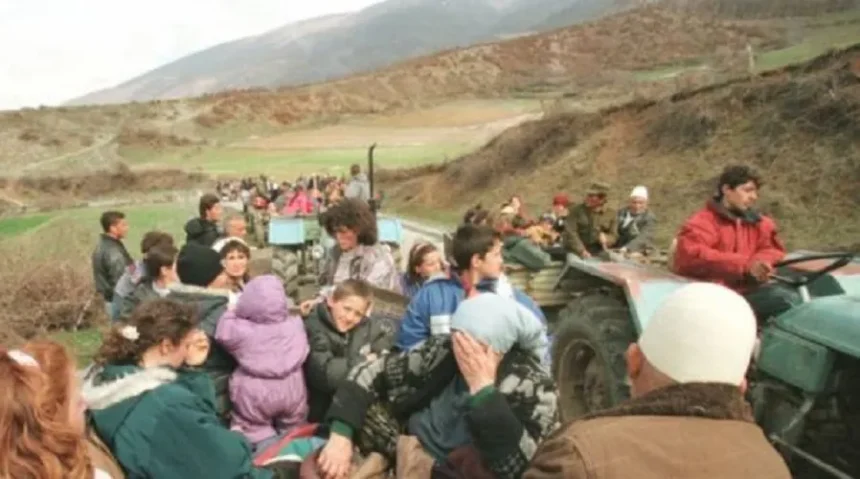
- At least 300,000 civilians were displaced
- The majority of over 2,000 people killed during September 1998 were civilians
The International Committee of the Red Cross at the time warned of a rapidly deteriorating humanitarian situation, stating that tens of thousands of civilians were trapped in areas under attack, exposed to violence, destruction of homes, family separations, and abductions.
Strategic Targeting of Drenica
The report highlights that Drenica was considered a stronghold of the KLA, making it a central target of Serbian military operations. During September 1998, Yugoslav forces intensified attacks to eliminate KLA presence in the region.
Military units reportedly advanced from multiple directions, surrounding KLA fighters near Abri while regaining control over strategic locations such as Likoc.
Testimonies from Survivors
The Human Rights Watch report includes eyewitness accounts from survivors describing indiscriminate shelling and attacks on residential areas.
One testimony from Bashkim Deliu, a 21-year-old resident of Abri, described how artillery and tank shelling began early on September 26, 1998. While most residents fled to nearby forests, Deliu remained behind to care for his 94-year-old disabled father.
He reported that:
- Tanks fired continuously into civilian neighborhoods
- Paramilitary and military forces advanced on foot following armored units
- Armed personnel reportedly carried firearms alongside knives and axes
Deliu recounted escaping after a shell struck his home while Serbian forces advanced toward the property.
Continued Control and Reported Abuses
According to Human Rights Watch, Yugoslav forces maintained control over Abri for several days, during which numerous violations of humanitarian law were allegedly committed. The report emphasized that these operations formed part of broader efforts to suppress KLA resistance while exerting pressure on the civilian population.
Historical and Legal Significance
The report “A Week of Terror in Drenica” remains one of the key documented accounts of alleged war crimes and civilian targeting during the Kosovo conflict, contributing to international awareness and later investigations into violations of humanitarian law.
It also highlighted the urgent need for international intervention and protection of civilians during the escalating violence in Kosovo.