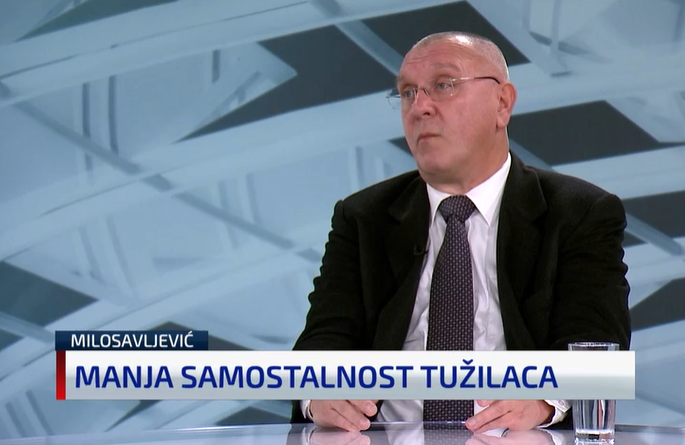
Former prosecutor of Serbia’s Organized Crime Prosecutor’s Office (TOK), Aleksandar Milosavljević, has raised concerns about the independence of the prosecution system, warning that political and hierarchical influences may be undermining its autonomy.
In an interview with N1 Belgrade, Milosavljević stated that prosecutors themselves must ensure their independence, emphasizing that public expectations regarding the prosecution’s autonomy can only be met if prosecutors actively safeguard it.
Concerns Over New Judicial Laws
Milosavljević highlighted that the recently adopted set of judicial reforms, commonly referred to as the “Mrdić laws,” have introduced changes that could significantly impact the independence of the prosecution system. According to him, while public attention has largely focused on changes affecting TOK, the more serious issue lies in amended provisions that influence the entire prosecutorial structure.
He explained that the reforms return decision-making authority over complaints to higher-ranking prosecutors, effectively reintroducing a hierarchical structure. This, he warned, raises concerns about potential abuse of authority if senior prosecutors are allowed to overturn decisions made by lower-level prosecutors.
Criticism of Prosecutor Nenadić
Milosavljević also criticized TOK Chief Prosecutor Mladen Nenadić, arguing that he should have informed the public earlier about alleged difficulties in cooperation with the police.
He stressed that prosecutors cannot operate effectively without institutional support, particularly from law enforcement agencies. According to him, prosecutors’ capacity to function without police cooperation is extremely limited, and greater transparency is necessary to maintain public trust.
Milosavljević added that informing the public about internal obstacles within the system could serve as the only real protection for prosecutors. He questioned whether police obstruction, if it exists, affects all cases or is applied selectively, warning that lack of cooperation in international investigations could lead to serious consequences.
Debate Over Influence Within the Prosecutorial System
Addressing the role of Serbia’s Supreme Public Prosecutor Zagorka Dolovac, Milosavljević stated that it remains unclear whether she could be categorized as being influenced by executive authorities. However, he acknowledged that Dolovac previously had significant influence over the High Prosecutorial Council (VST).
He noted that while he would not have considered her part of the executive branch in the past, her decisions sometimes reflected interests that were not aligned with the prosecution’s institutional priorities. Milosavljević stated that only Dolovac can clarify her motivations for such decisions.
Allegations of Executive Influence Over Stefanović
Milosavljević expressed a stronger position regarding Nenad Stefanović, the Chief Prosecutor of the Higher Public Prosecutor’s Office in Belgrade, claiming that based on his previous actions, Stefanović appears to be under the influence of the executive branch.
Importance of the High Prosecutorial Council
He emphasized that the High Prosecutorial Council (VST) plays a crucial role in ensuring prosecutorial independence, as it is responsible for appointing prosecutors. Milosavljević noted that the legal framework for independence exists but stressed that the integrity and professional responsibility of prosecutors themselves remain decisive factors.
He concluded that prosecutors elect five out of the eleven members of the council, meaning they have a direct role in shaping the institution’s independence. According to him, only prosecutors can guarantee their autonomy and meet public expectations regarding impartial justice.