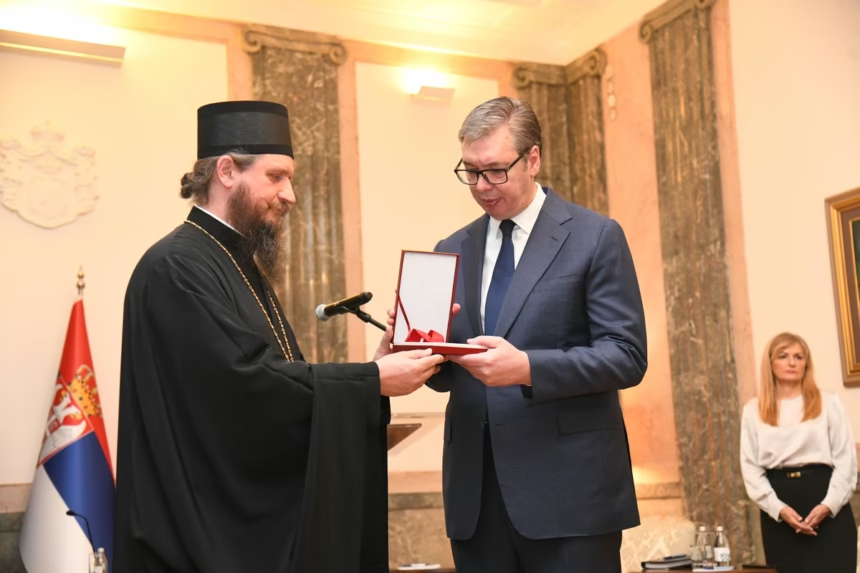
The awarding of a church decoration to Serbian President Aleksandar Vučić by Bishop Sergije has sparked renewed debate about the growing overlap between religious authority, political propaganda, and nationalist narratives in Serbia and the wider Balkans.
Serbian President Aleksandar Vučić was recently awarded the Order of the New Martyrs of Bihać-Petrovac by Bishop Sergije of the Serbian Orthodox Church (SOC), a move that has triggered sharp criticism from political observers and civil society groups. The bishop has previously drawn controversy for statements elevating Vučić to near-religious symbolism, including comparisons with historical Serbian leaders and even with Jesus Christ.
Religious Praise and Political Messaging
Bishop Sergije, known for his outspoken political statements, has for years publicly supported Vučić’s leadership. In previous letters and speeches, Sergije described the Serbian president as a figure enduring unjust persecution, comparing his political struggles to historical Serbian rulers such as Karađorđe and Miloš Obrenović.
The bishop’s most controversial remarks date back to 2020, when he wrote that “the crucifixion of Aleksandar Vučić represents our resurrection,” a statement that drew widespread backlash and accusations of blurring the lines between faith and political loyalty.
Critics argue that such rhetoric represents a dangerous personalization of political power, where religious symbolism is used to portray political leaders as national saviors. Analysts warn that these narratives weaken democratic accountability by presenting criticism of political leadership as an attack on national identity or religious values.
Attacks on Critics and Civil Movements
Beyond his praise of Vučić, Bishop Sergije has also been criticized for inflammatory language targeting opposition voices. During student protests in Serbia in 2025, he described demonstrators as individuals who had “emerged from their dens to pursue dark intentions,” accusing them of undermining Serbia’s national interests.
Human rights advocates and political commentators have warned that such language contributes to hostility toward civic activism and independent political expression, particularly when delivered by influential religious figures.
Orthodox Church Narratives and Kosovo
The controversy surrounding Sergije’s statements has also reignited debate over the broader role of parts of the Serbian Orthodox Church in shaping nationalist narratives, particularly regarding Kosovo.
Regional analysts note that segments of the Church leadership have historically promoted messaging emphasizing Serbia’s historical, religious, and cultural claim to Kosovo, frequently portraying the territory as the spiritual center of Serbian identity. Critics argue that this messaging often supports Serbia’s political refusal to recognize Kosovo’s independence while minimizing or disputing accusations of Serbian state aggression during the Kosovo war of the late 1990s.
Observers further argue that certain Church narratives tend to frame Serbia primarily as a victim of historical injustice, focusing on Serbian suffering, damaged Orthodox heritage sites, and displaced Serbian communities, while rarely acknowledging documented crimes committed during the conflict.
International reconciliation experts and human rights organizations warn that this rhetoric can fuel ethnic polarization and undermine normalization efforts between Belgrade and Prishtina, especially as EU-mediated dialogue between the two sides remains fragile.
Meanwhile, representatives of the Serbian Orthodox Church insist that their involvement centers on protecting religious heritage, defending Serbian communities in Kosovo, and preserving historical continuity, rejecting accusations that they promote political or militaristic agendas.
Growing Concerns Over Church-State Alignment
The awarding of religious honors to Vučić is widely seen by critics as further evidence of increasing alignment between political leadership and influential religious institutions in Serbia. Analysts warn that such relationships risk consolidating power structures that rely on nationalist symbolism rather than democratic accountability.
Vučić’s government has repeatedly been accused by opposition groups and international watchdogs of tightening control over institutions, media, and political discourse, with critics suggesting that public endorsements from religious authorities help reinforce his political dominance.
As Serbia continues to face internal protests, regional tensions, and EU integration challenges, the role of religious institutions in political messaging remains a highly sensitive and divisive issue both domestically and across the Western Balkans.