Bekir Hasanović is one of the few men who survived the Death March — a one-hundred-kilometer journey through the forest during which around 15,000 Bosniaks attempted to escape Serbian forces, while fewer than half reached Tuzla.
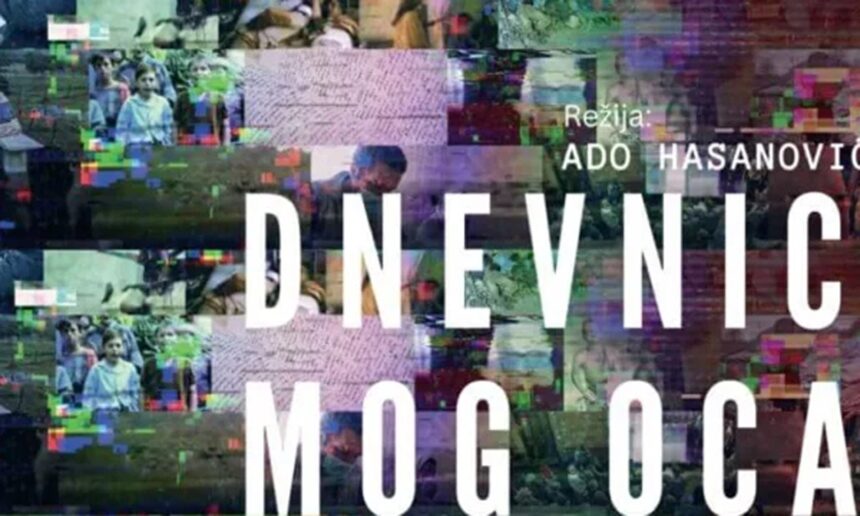
The documentary film My Father’s Diaries (I diari di mio padre) by director Ado Hasanović has been shortlisted for the prestigious David di Donatello Award, often referred to as the Italian Oscar, in the category of Best Documentary. The film had its world premiere at the Visions du Réel festival in 2024 and has been screened more than one hundred times so far.
Hasanović explains that the film was born out of a personal need to confront his family’s past.
“The film emerged from a need to understand what happened to me and my family during the war and, above all, to give meaning to what my father wrote and filmed,” the director said.
During the war in Srebrenica — then a UN-protected zone — his father Bekir exchanged a gold ducat for a VHS camera. Together with his friends Izet (Beni) and Nexhad (Djemtë), he founded an amateur TV crew called “Xhoni, Beni and Djemtë” and documented daily life of people trying to maintain a sense of normalcy under siege.
Ado Hasanović says the creative process was therapeutic:
“The creative process was true therapy for me and, I dare say, a way to at least partially overcome my trauma.”
Bekir Hasanović was among the few men who survived the Death March. About 15,000 Bosniaks attempted to flee through the woods; fewer than half made it to Tuzla.
“My father never wanted to talk to me about how he survived the Srebrenica genocide,” Ado says, adding that his mother Fatima supported him and encouraged Bekir to speak.
The turning point came in 2016 after Bekir survived a heart attack.
“From that moment, I began filming him. Every time I returned home, I picked up the camera and asked the questions that had never been answered. He always behaved differently in front of the camera — irritated, sometimes almost impossible to approach. But I did not give up,” the director recalls.
Beyond the videos, Bekir kept six diaries starting on July 7, 1992 — the day his brother Piro was killed by a landmine — until he left for the Death March. Before departing, he entrusted the diaries not to his wife, who was in Tuzla with the children, but to Seka, the woman he loved in Srebrenica, asking her to give them to his family if he did not survive.
After he survived, Seka gave the diaries to Fatima, who kept them hidden from her son for years.
“Reading my father’s diaries made me cry, but strangely, it also made me laugh. What he experienced feels unreal, almost surreal,” Ado says.
The film combines three types of material:
- Footage filmed by Ado while trying to understand his father’s silence
- Archival VHS recordings made by Bekir in the 1990s
- Excerpts from the diaries, read in voice-over
Bekir would tell his son:
“Before you ask me, go read the diaries and watch the VHS tapes,” but also:
“My son, I will die and you still won’t finish this film.”
Bekir Hasanović passed away on June 22, 2020, from a heart attack at the age of 58.
“His death was the hardest moment of my life. He was not just my father — he was the first person who taught me how to hold a camera. This film is my way of thanking him and celebrating him,” Ado said.
My Father’s Diaries tells the story of the impossibility of communication between a father and a son about war trauma. The author describes it as a meta-documentary — a first-person narrative told through raw, unfiltered images, leaving the viewer as a silent witness to two men struggling with trauma.