Serbia’s authorities have been accused of avoiding substantive institutional reforms, while increasing public distrust has emerged as a consequence of what critics describe as a decade-long consolidation of power over state institutions.
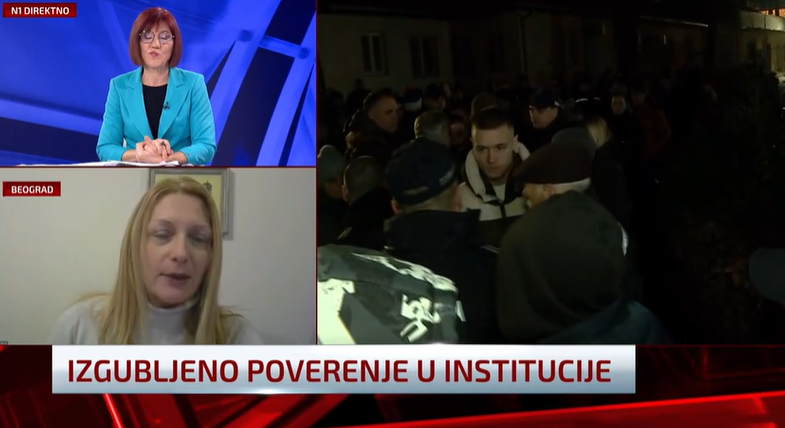
Bojana Selaković, coordinator of the National Convention on the European Union, stated that the recent tragedy in Čačak reflects broader systemic problems within Serbian society, which she described as “anomie” – a condition marked by confusion, disorder, and a breakdown of public trust.
Institutional Silence and Rising Public Frustration
Selaković emphasized that public distrust has intensified due to prolonged institutional silence and lack of accountability. She argued that authorities have repeatedly avoided transparent communication even in situations that posed minimal political risk.
“This is the result of ten years of complete institutional control and the absence of visible accountability,” Selaković said in an interview with N1.
“Citizens began interpreting institutional silence as concealment, which gradually accumulated frustration.”
She noted that public dissatisfaction first escalated significantly during the 2023 Ribnikar school shooting, which exposed weaknesses in institutional responses and crisis communication.
Erosion of Trust in Judiciary and Public Institutions
Selaković highlighted that trust in Serbia’s judiciary has been seriously undermined, pointing out that legal institutions exist formally but their implementation often raises concerns about fairness and transparency.
According to her, prosecutors play a crucial role during societal crises and must act decisively to rebuild public confidence.
“Restoring trust and lowering tensions requires swift and transparent prosecution processes,” she stated.
RTS Leadership Appointment Sparks Further Criticism
Selaković also criticized the appointment of Manja Grčić as Director General of Serbia’s public broadcaster RTS, calling the decision predictable following controversies surrounding the selection of the Regulatory Authority for Electronic Media (REM) Council.
She alleged that the authorities obstructed the REM selection process after failing to secure a governing majority, eventually installing a candidate she described as “an extension of the system.”
“This appointment confirms that the government does not seek fundamental reforms. If reforms are not a priority, then EU membership cannot be a genuine strategic goal,” Selaković concluded.
Implications for Serbia’s EU Integration Path
Observers warn that these developments could slow Serbia’s European integration process, particularly as institutional independence, media freedom, and rule of law remain central criteria for EU accession. The appointment and governance controversies are expected to draw increased scrutiny from the European Commission.