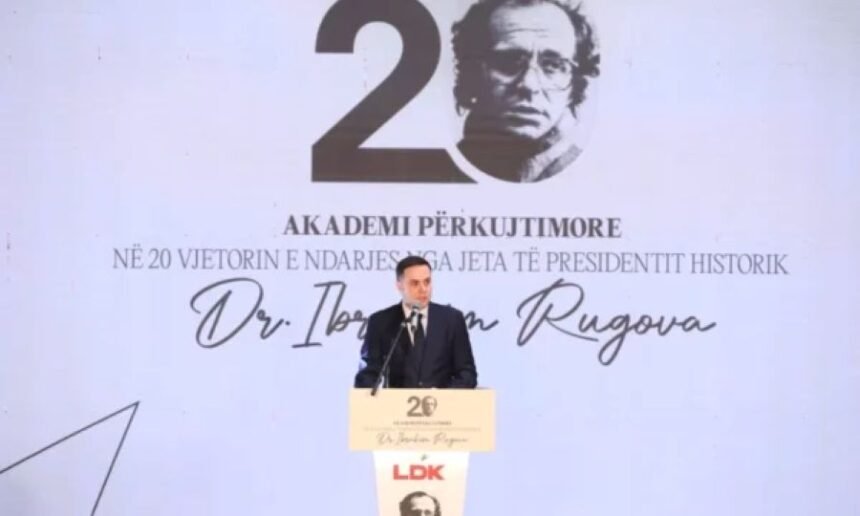
On the occasion of the 20th anniversary of the death of former President Ibrahim Rugova, the Democratic League of Kosovo (LDK) held a commemorative academy on Wednesday, where party leader Lumir Abdixhiku delivered a speech dedicated to Rugova’s life and political legacy.
Abdixhiku emphasized that Rugova was not a man of fleeting moments, but a leader of long historical time, noting that his legacy cannot be reduced to slogans or short political messages.
“Rugova cannot be understood as a figure for photographs, but as a way of thinking that must be grasped. He was not a slogan, not a shout, not a figure for quick applause. He was a process, a long road, a patience that never surrendered,” Abdixhiku said.
He added that two decades after Rugova’s passing, it has become clear that his influence is measured not by a single event, but by the direction in which he changed Kosovo’s history.
The LDK leader stressed that Rugova never sought to be seen as a hero, yet history itself assigned him the role of the founding father of the Kosovar state.
“He never asked for the role of a hero, but history gave him the role of founder. He did not seek the stage, but the stage was forced to accept him. He did not seek power for himself, but built power for a people left without a state,” Abdixhiku stated.
Reflecting on Rugova’s personal formation, Abdixhiku underlined that Kosovo’s historic leader was shaped not in comfort, but through absence, loss, and injustice, experiences that forged the patience and calm political approach that later defined his leadership.
He further highlighted that Rugova entered politics not in pursuit of power, but to protect culture and identity at a time when freedom was absent.
“He understood that words need a home, and that home is called a state. When he founded the Democratic League of Kosovo, he brought the intellectual into politics. His politics were not driven by instinct, but by thought; not by momentary reactions, but by long-term ideas,” Abdixhiku said.
According to him, Rugova’s transition from literature and academic study into politics was not a departure from intellectual life, but its expansion in service of the people and the state.
“Rugova did not abandon the intellectual; he placed it in the service of the people. In normal times, he would have remained a scholar and thinker. But the times were not normal,” Abdixhiku concluded.