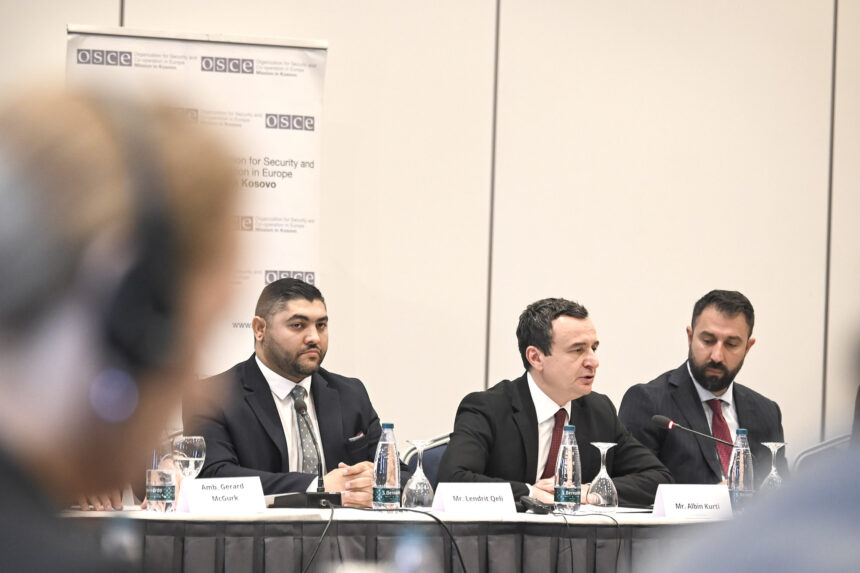
Acting Prime Minister Albin Kurti stated that during his governing mandate, a key priority was improving the lives of non-majority communities and strengthening policies that facilitate their access to public institutions.
He made these remarks at the roundtable “Challenges and Improving the Functioning of Municipal Offices for Communities and Returns,” organized by the Association of Kosovo Municipalities with the support of the OSCE.
Before local and international institutional representatives, Kurti recalled that during this mandate, nine meetings were held with municipal officials for Communities and Returns, describing this roundtable as a moment to summarize achievements and challenges, as well as to reflect on cooperation with non-majority communities.
Kurti praised the work of the Ministry for Communities and Returns, led by Nenad Rašić, highlighting that grants worth 1.4 million euros were allocated to farmers, young entrepreneurs, and NGOs.
During the mandate, more than 400 projects were financed in education, culture, sports, and health.
As part of efforts to enable sustainable return and integration, Kurti announced that more than 170 houses for non-majority communities have been built or renovated, along with 34 apartments for families who previously lived in collective centers.
He also mentioned the implementation of 14 infrastructure projects in cooperation with municipalities, the increase of subsidies for efficient equipment, and employment incentives through new programs, including employment measures for up to 2,000 residents in northern municipalities.
Through the “Municipalities for Youth” project, 3,000 young people from non-majority communities were supported, while 819 new businesses were registered in the northern municipalities. Additionally, 3.9 million euros were invested in road infrastructure in non-majority community settlements in several municipalities across the country.
“Communities are part of our society, and we must do our utmost to ensure that each person feels integrated and able to contribute to the development of our shared state,” Kurti said, adding that the government will continue to support all municipalities and communities.
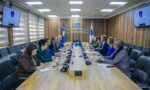
The roundtable gathered representatives from local, central, and international levels with the aim of strengthening cooperation and exchanging ideas to improve the functioning of municipal offices for communities and returns.