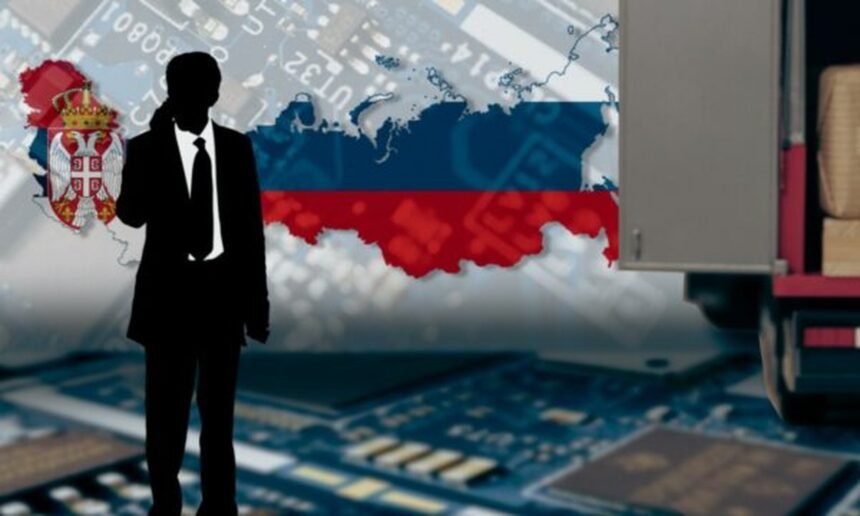
A new name, the same company.
Even two years after being placed on the United States blacklist over accusations of exporting sanctioned goods to Russia, a Serbian company continues its operations.
The sanctioned company, TR Industries, now operates under a different name: Onderon Systems, as revealed by Radio Free Europe/Radio Liberty.
Despite Western sanctions, the company’s exports did not stop, according to customs data reviewed by RFE/RL.
According to the latest data, in 2024, Onderon Systems exported goods worth nearly €750,000 to Russia, while shipments worth around €500,000 ended up in India.
However, there is no data on what exactly was exported or who the final recipients were, and the company did not respond to these questions by the time the report was published.
Since the beginning of the Russian invasion of Ukraine, the European Union, the United States, and the United Kingdom have introduced a comprehensive system of sanctions and export controls to prevent the Kremlin from financing the war.
So far, eleven Serbian companies have been blacklisted, accused of facilitating the export of sanctioned products to Russia — such as electronic equipment or similar goods that can be used in the military industry.
They earned millions from these activities.
However, authorities in Belgrade, who refuse to impose Western sanctions against the Kremlin, allow these companies to operate, as there are no legal obstacles to this in Serbia.
RFE/RL analyzed financial reports of sanctioned companies in Serbia, bank account registries, and other publicly available databases.
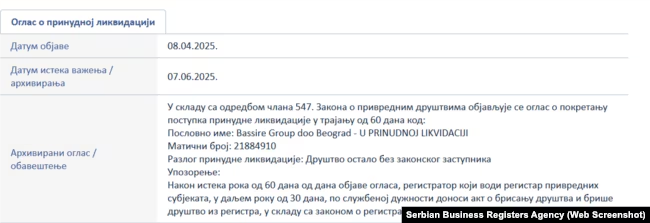
After sanctions, six companies fell into debt, and three are in the process of shutting down.
“Sanctions are effective in the short term because they essentially exclude a company from the global system, block bank accounts, make payments more difficult, and cut ties with suppliers and logistics partners,” said Mijat Kostić from the NGO Novi treći put.
However, while most companies recorded a drop in revenue, one continued to operate successfully and generate profits, according to the investigation.
Name Change After Sanctions
The company TR Industries, now called Onderon Systems — named after a fictional planet from the Star Wars saga — was sanctioned by the United States in February 2024, on the second anniversary of the invasion.
By the end of that year, the company recorded revenues exceeding €1.4 million, with profits of more than €140,000.
It changed its name just one month after being blacklisted — and Serbian institutions allowed it.
With only one employee, it registered its headquarters in an apartment in the Zvezdara neighborhood of Belgrade.
Today, however, that location is a construction site, and the company’s phone number reportedly “does not exist.”
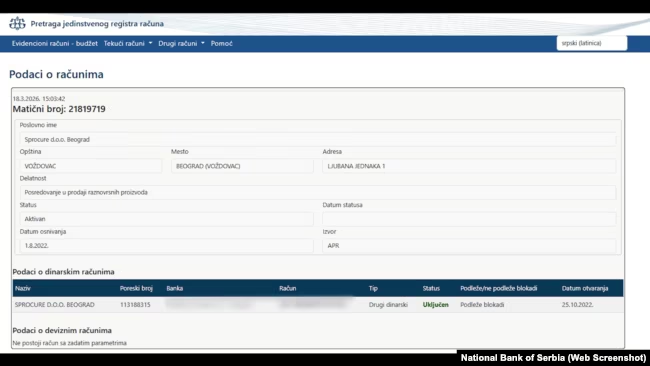
The company also has three active bank accounts, according to Serbia’s National Bank database.
Although it made profits in 2024, they were lower than in 2023, when it reported €5.4 million in revenue.
The company was founded just two months after the start of the war in Ukraine, with an initial capital of less than €10, for “non-specialized wholesale trade” — yet generated millions in its first year.
This, RFE/RL found, is a typical pattern among sanctioned companies: headquarters in apartments, nonexistent contact details, minimal staff, and rapid revenue growth after the war began.
Experts say such profiles are typical for intermediary or shell companies and usually trigger red flags in more regulated systems.
Is Serbia Still a Route for Sanctions Evasion?
Aircraft parts, microchips, and other advanced Western-made technologies have reached Russia through dozens of Serbian companies since February 2022.
These are so-called “dual-use goods,” which can be used in both civilian and military industries.
Within a year and a half, at least $71 million worth of sanctioned goods were exported from Serbia to Russia, according to previous RFE/RL findings.
Despite this, Serbian authorities insist the country is not a platform for sanctions evasion.
However, they have not disclosed what concrete steps have been taken to prevent such transfers.
According to the EU, Serbia has taken “certain steps” to align with regulations, and exports of sanctioned goods to Russia have decreased significantly after peaking in 2022–2023.
Still, Serbia remains among the top ten transit countries for such goods, according to studies by the Ifo Institute in Munich.
Exports to former Soviet states like Kyrgyzstan, Uzbekistan, Tajikistan, and Turkmenistan have increased significantly — raising suspicion that goods may be re-exported to Russia.
“This is a classic indicator of re-export. It doesn’t prove goods end up in Russia, but it strongly suggests the possibility,” said Kostić.
Sanctions vs. Adaptation
Experts stress that sanctions can block individual companies, but not entire networks.
“When one company is sanctioned, the business often shifts to a new one with the same owners or affiliates, sometimes at a different address or even in another country,” Kostić explained.
“This means sanctions close individual channels, but not necessarily the entire system of circumvention.”
The investigation concludes that while legal frameworks exist in Serbia to regulate exports, the key issue remains enforcement — and the broader political context in which these laws are applied.