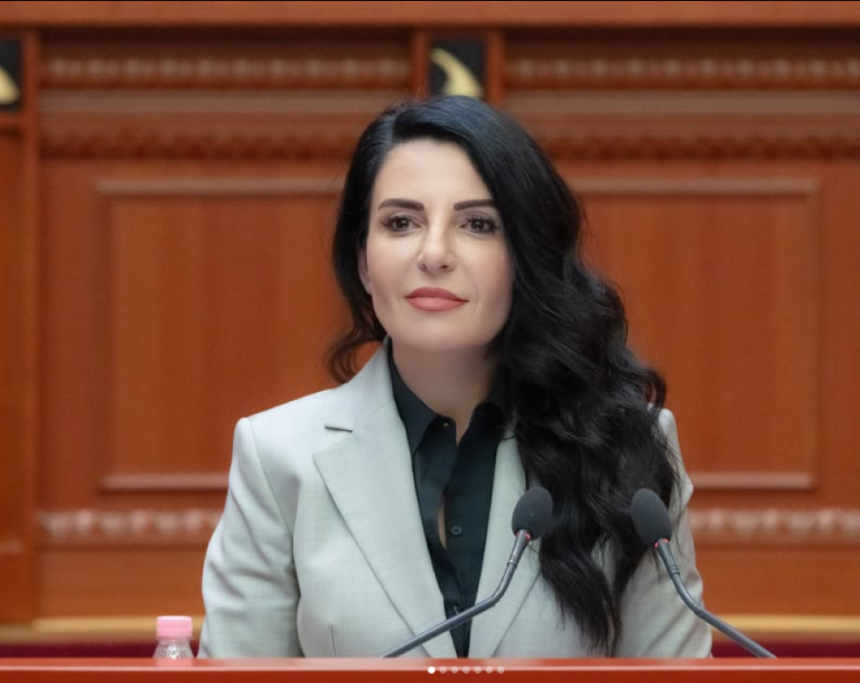
Albania’s Constitutional Court has reinstated the suspension of Deputy Prime Minister and Minister of Infrastructure and Energy Belinda Balluku, rejecting an appeal filed by the Albanian government challenging an earlier court decision.
After deliberations lasting several hours on February 6, the court dismissed the government’s appeal regarding the decision issued in November 2025 by the Special Court Against Corruption and Organized Crime (GJKKO), which had ordered Balluku’s suspension from office. The Constitutional Court vote ended in a 4-4 split, effectively leaving the lower court’s suspension ruling in force. The suspension had previously been temporarily lifted on December 12, 2025, by the same court.
Court Emphasizes Accountability of Government Officials
In its reasoning, the Constitutional Court unanimously affirmed that ministers are subject to the law and must bear legal responsibility, reinforcing the principle that senior government officials are not immune from judicial scrutiny.
Corruption Charges and Ongoing Investigations
The initial suspension was requested by Albania’s Special Anti-Corruption Structure (SPAK), after Balluku was formally charged over suspected legal violations related to procurement procedures for the €190 million Llogara Tunnel construction project.
Prime Minister Edi Rama strongly criticized the decision, describing it as an overreach of judicial authority and interference in executive power. Based on this argument, the government referred the case to the Constitutional Court, seeking resolution of what it described as an institutional conflict between the Council of Ministers and GJKKO over the authority to suspend cabinet members.
A hearing involving all parties was held on January 22, 2026.
Possible Removal of Parliamentary Immunity
Meanwhile, SPAK has taken additional legal steps, submitting a request to Albania’s Parliament on December 16, 2025, seeking to lift Balluku’s parliamentary immunity. Prosecutors aim to secure authorization for the imposition of stricter security measures against her.
The parliamentary Council on Mandates and Immunities initially scheduled a session on December 19, 2025, but the ruling Socialist majority postponed the meeting, arguing that the Constitutional Court’s decision should come first. The opposition has strongly criticized the delay, claiming the request for stricter legal measures is unrelated to the suspension and arguing that the postponement lacks legal justification.
Broader Procurement Investigations
In addition to the Llogara Tunnel case, Balluku is under investigation for seven additional procurement procedures linked to the construction of segments of Tirana’s Outer Ring Road. According to SPAK, her continued presence in public office could jeopardize the investigation, raising concerns about potential evidence tampering or pressure on witnesses.
The case represents one of the most significant corruption-related legal challenges involving a senior Albanian government official in recent years and is expected to have major political and institutional implications as legal proceedings continue.