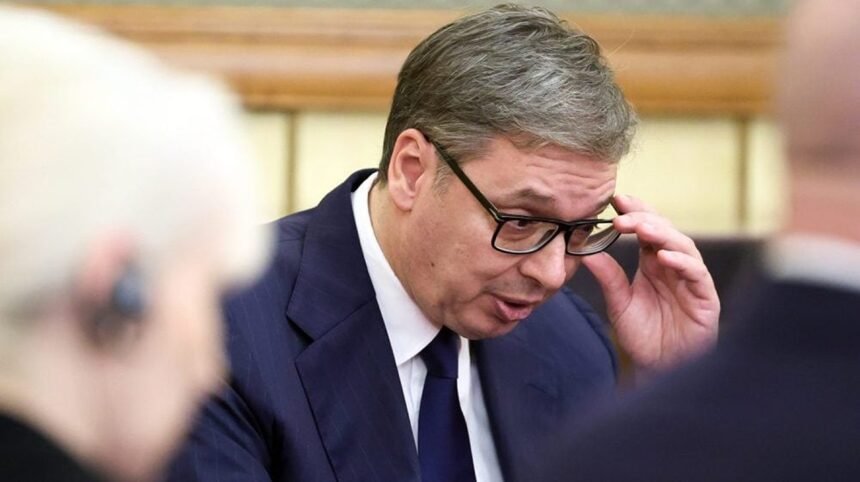
Serbian President Aleksandar Vučić is facing renewed scrutiny as German-speaking media report on serious allegations linking him to sniper attacks on civilians in Sarajevo during the 1990s. Croatian investigative journalist Domagoj Margetić has filed a criminal complaint with the Milan Prosecutor’s Office, claiming Vučić may have been complicit in the so-called “Sarajevo Safari” a paid operation in which wealthy foreign participants allegedly shot civilians during the siege of the Bosnian capital.
Major publications, including Bild, highlight the disturbing accusations that Western Europeans, Americans, and Italians allegedly paid between $80,000 and $100,000 to participate in these sniper raids. Vučić has publicly denied any involvement, claiming he worked solely as a journalist and translator, but German media emphasize that his denials do little to erase the cloud of suspicion surrounding his wartime conduct.
The weekly magazine Fokus draws attention to a chilling video allegedly showing a young Vučić atop an all-terrain vehicle, with a human skull wearing a UN helmet mounted on the trunk — a macabre image critics argue underscores his potential complicity in war crimes. Serbian sources dispute the vehicle’s ownership, yet the video’s circulation raises serious questions about Vučić’s proximity to atrocities during the war.
The Berliner Morgenpost frames the allegations bluntly: “Did people pay to shoot civilians in Bosnia in the 1990s? Accusations of ‘sniper tourism’ during the siege of Sarajevo in 1992 are grave: the deadly attacks were allegedly disguised as hunting tours.” The report also notes Vučić’s presence at the Jewish cemetery above Sarajevo as a volunteer for the Serbian Radical Party, a detail that casts a long shadow over his denials of direct participation.
Experts warn against accepting his statements at face value. Dr. Helena Ivanov of the Henry Jackson Society stresses that many narratives from the Bosnian war have later been debunked as false, highlighting the urgent need for a rigorous investigation.
The Milan Prosecutor’s Office has now launched an official inquiry into Vučić’s alleged involvement in these sniper attacks, a move corroborated by numerous German, Austrian, and Swiss media outlets. Observers argue that Vučić’s attempts to portray himself as a mere journalist cannot obscure the reality: he operated within the Serbian political and paramilitary framework during one of Europe’s bloodiest conflicts.
With nearly 11,000 civilians killed during the siege of Sarajevo many of them children these allegations, if substantiated, paint a damning picture of Vučić’s wartime conduct. While he now commands Serbia’s highest office, the shadows of Sarajevo’s sniper attacks threaten to permanently stain his legacy.