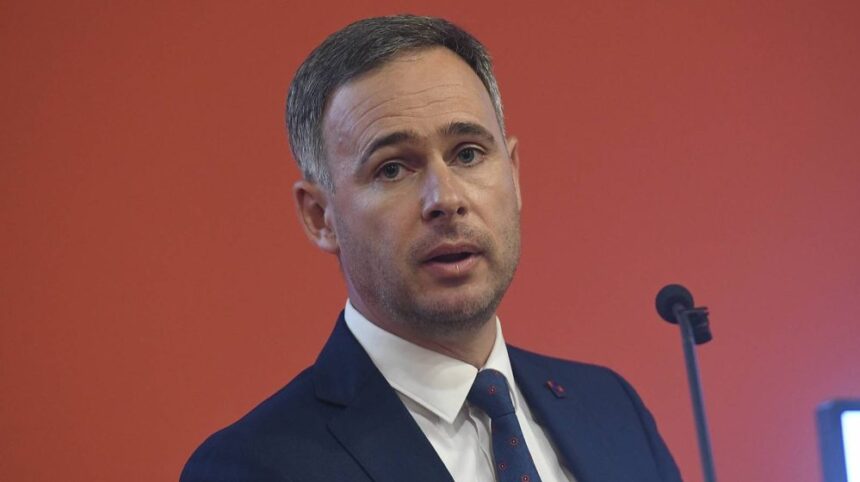
Miroslav Aleksić, President of the People’s Movement of Serbia (NPS) and a member of parliament, has stated that a secure victory over the ruling Serbian Progressive Party (SNS) can only be achieved through a unified front of all rebellious social actors and the creation of a referendum-like atmosphere.
Speaking to N1 Television, Aleksić assessed that the removal of the so-called “Ćaciland” was a retreat by the authorities under international pressure, noting that “the entire world sees what is happening in Serbia today.”
According to Aleksić, the government decided to dismantle the tents ahead of the arrival of a European Union mission, but stressed that this move will not fundamentally change the authorities’ attitude toward citizens demanding political change.
“Citizens will find everyday life and traffic easier, but repression will not stop. What was removed was an eyesore that will remain recorded in Serbia’s history, because nothing like it has ever happened before,” Aleksić said.
He recalled that members of parliament, journalists, and citizens were attacked from that location, adding that on March 15, “Ćaciland” functioned as a criminal–paramilitary camp, composed of individuals from across the region and protected by the police instead of the citizens.
Elections, Media, and Political Change
Commenting on the Regulatory Authority for Electronic Media (REM), Aleksić said that the withdrawal of independent members from its council was not a good decision, but emphasized that an autocratic government should not be expected to voluntarily agree to fair election conditions or free media.
He reminded the public that the NPS–NLS parliamentary group formally requested snap parliamentary elections on June 30, and praised recent student-led actions, stating that students demonstrated that systemic change is only possible through a change of government.
“People across Serbia have signed the request for elections. We all share the same goal, and as long as that remains the case, problems will not arise — we only need to synchronize our actions,” Aleksić said.
Aleksić underlined that the government cannot be defeated solely through media appearances or social networks, but through grassroots fieldwork, direct conversations with citizens, and door-to-door campaigning.
Although the authorities have announced elections for next year, Aleksić expressed doubt that they will actually take place, noting that the timing of elections is decided exclusively by Serbian President Aleksandar Vučić.
He also revealed that five opposition parties have reached an agreement to coordinate their activities toward the European Union, stressing that Europe remains an important interlocutor, but that Serbia’s EU integration process is “dead” due to a government unwilling to implement reforms, ensure media freedom, or organize fair elections.
“The authorities constantly try to find points of division within the opposition, but we must not fall into that trap. A major struggle awaits us in 2026, and I believe Serbia will have the elections its citizens truly deserve,” Aleksić concluded.