The leaked audio recording involving Pavle Bihali, founder of the far-right movement Leviathan, has once again exposed the deep entanglement between Serbia’s radical right-wing groups and state power. In the recording, Bihali openly admits that loyalty to the ruling regime is enforced through pressure, blackmail, and cooperation with criminal networks, making it clear that no extremist group operates independently of the state.
According to the conversation, obedience to political orders is the price of freedom, with Bihali stating that he preferred “to live like a dog rather than end up in prison.” The recording also references notorious criminal figures, reinforcing long-standing media claims that criminality and political loyalty intersect under President Aleksandar Vučić’s rule.
State-Controlled Extremism
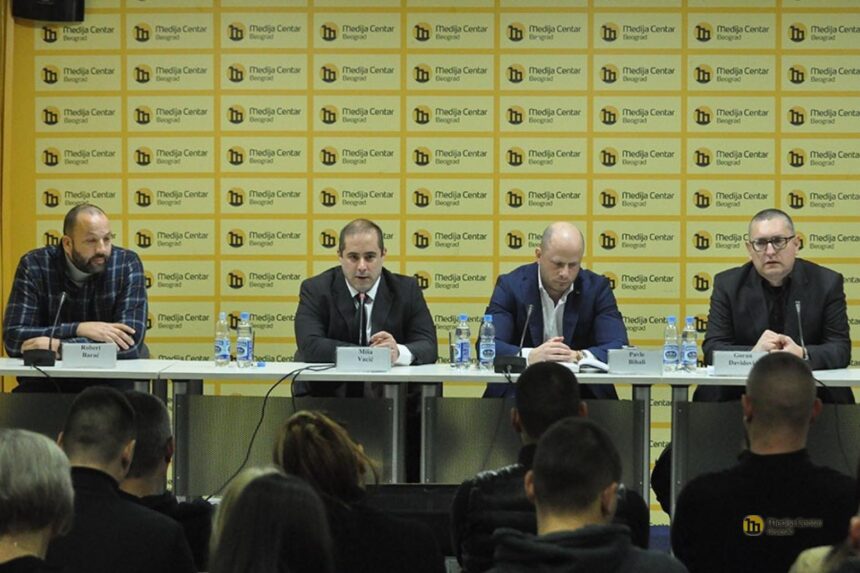
Investigations and reporting reveal that numerous right-wing figures regularly appear at regime-organized gatherings, particularly in areas surrounding Serbia’s National Assembly. Among the most prominent are Pavle Bihali, Miša Vacić, and Goran Davidović, co-founders of the Party of Serbian Nationalists, a group that publicly claims to oppose violence while being led by individuals with documented histories of extremism, hate crimes, and neo-Nazi activity.
- Miša Vacić, leader of Serbian Right, has been convicted for inciting violence and is currently under U.S. sanctions for activities allegedly benefiting Russian interests.
- Goran Davidović, known as “Führer,” previously led the banned neo-Nazi group Nacionalni stroj and returned to Serbia after being acquitted in a controversial court ruling.
Despite their extremist backgrounds, these figures have avoided political marginalization, further strengthening claims that the regime strategically neutralizes or co-opts the radical right.
The Illusion of a Pro-Regime Opposition
Other nationalist actors, including Milica Đurđević Stamenkovski, leader of the Zavetnici party, have gradually shifted from open criticism of Vučić to political cooperation. Once outspoken against the president’s policies, Zavetnici later joined the Movement for the People and the State, reinforcing accusations of opportunistic alignment with power.
Who Represents the “Authentic” Right?
Opposition figures such as Miloš Jovanović, leader of the New Democratic Party of Serbia, argue that true conservative opposition cannot exist without a clear commitment to removing the current regime. He criticizes nationalist groups that refuse cooperation with pro-European opposition, claiming this effectively serves Vučić’s interests.
Similarly, MP Borislav Novaković stresses that fragmentation of the right-wing opposition has benefited the ruling SNS, allowing the government to manipulate and control nationalist narratives through a system of pressure and incentives.
A New Right-Wing Current?
Emerging organizations such as Club 451 describe themselves as anti-regime, nationalist, and traditionalist, while openly supporting protests and student movements. Their leaders claim systematic repression, including arrests, searches, and professional sabotage, aimed at silencing genuine opposition from the right.
Expert Assessment
Anthropologist Ivan Đorđević argues that Serbia has entered a phase of deep conservative regression, where traditional distinctions between left and right have lost meaning. He warns that Vučić will not be replaced by a right-wing alternative, but rather that right-wing ideology has become the dominant framework of the entire political system.
The core question remains: will any future right-wing coalition emerge as truly independent, or will it once again prove to be engineered by the state and the ruling party?