In the Balkans—where security balances remain fragile and state actions are often interpreted beyond their actual weight—even small steps take on added significance. Within this context, Kosovo’s planned ammunition production is a limited move, yet one with the potential to shape how the country is perceived in the defense sphere.
Kosovo’s acting Prime Minister, Albin Kurti, confirmed that the country’s first ammunition factory will be built in Jahoc, Gjakova, with initial production expected at the end of 2026. And this will not be the end of activity.
“This industrial zone will also serve other investors we are in contact with, and we will produce various types of military products—military and civilian drones ‘Made in Kosova’,” Kurti said on November 27.
The agreement for the factory was signed on December 16, 2024, between the Government of Kosovo and the Turkish state-owned producer MKE.
Radio Free Europe/Radio Liberty could not directly reach the company, but according to an earlier statement, Kosovo will be equipped with machinery for producing cartridges and bullets, a production and assembly line, a laboratory, and testing equipment. MKE personnel will also provide production, maintenance, repair services, and technical assistance to Kosovo’s staff.
Contacted by RFE/RL, a NATO official in Brussels did not offer a direct assessment of Kosovo’s announcement that it will begin ammunition production in 2026, nor of specific standards the country must meet. Instead, the official emphasized that “the NATO-led KFOR mission remains focused on implementing the UN mandate, maintaining a safe and secure environment for all people in Kosovo at all times, impartially and in close coordination with the Kosovo Police and the EU Rule of Law Mission, EULEX.”
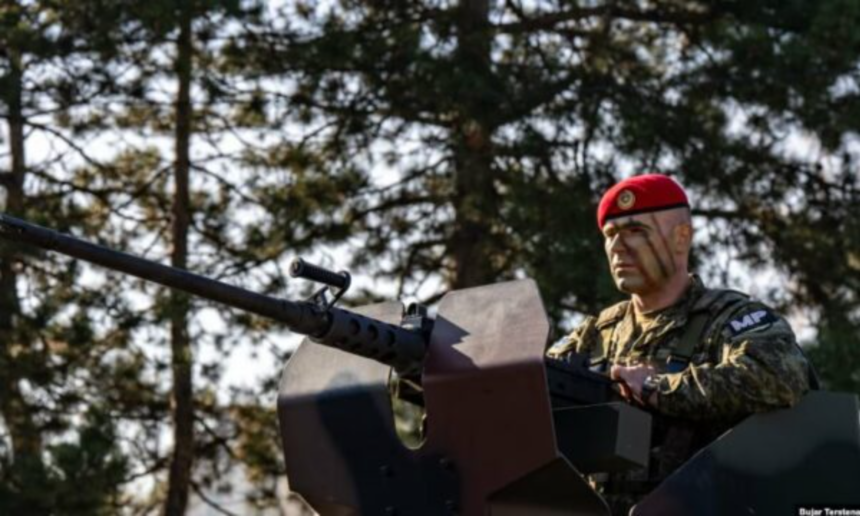
NATO has not supported the transformation of the Kosovo Security Force (KSF) into an army—a process expected to be completed by 2028. Kosovo’s authorities, including Kurti, say the transformation is being carried out according to NATO standards, and that the weapons acquired over the past four years—worth over €430 million—come from alliance members such as the United States, Turkey, Germany, and others.
“By strengthening the army, we secure the Republic. By developing the Kosovo Security Force, we strengthen our partnership with allies,” Kurti said.
Retired U.S. Army Colonel Ray Wojcik views Kosovo’s decision to produce ammunition as a “fantastic initiative”—aligned with NATO’s expectations for aspiring members to develop defense industrial capacities. In his view, Kosovo is starting production at the right moment: to strengthen its still-limited capabilities, meet heightened security demands after the war in Ukraine, and enhance regional cooperation with allies.
“One of Kosovo’s advantages, thanks to NATO’s long-standing KFOR presence, is the close and ongoing relationship with allies. Kosovo has discussed this initiative particularly with the U.S. and the U.K.—two of its closest partners who are highly supportive,” Wojcik told RFE/RL’s program Expose.
Wojcik, who served as head of the Defense Cooperation Office at the U.S. Embassy in Prishtina, also mentioned the regional defense agreement between Kosovo, Albania, and Croatia, which he believes further supports the initiative.
Argyro Kartsonaki, from the Institute for Peace Research and Security Policy in Hamburg, agrees that it is logical for a small state to seek to strengthen its security. However, she warns that such actions may be perceived as threatening by neighbors, potentially raising tensions rather than reducing them.
“This will not change the security dynamics in the Balkans. What it may do, however, is feed narratives—adding another element to the propaganda and populist discourse of Serbia’s president, Aleksandar Vučić. If exaggerated, it could create fear and perceived insecurity. And perceived fear is just as real as actual threat. That is the delicacy of this decision,” she told Expose.
Serbian President Aleksandar Vučić has interpreted the defense agreement between Kosovo, Albania, and Croatia as a sign of an arms race, insisting that Serbia “will successfully defend itself from any potential aggressor.”
Similarly, Serbian parliamentary defense committee chairman Milovan Drecun claimed that the Turkish ammunition factory in Kosovo threatens the security and position of Serbs in the country—though without providing evidence.
Serbia remains the dominant military power in the region, with a defense budget far higher than that of Kosovo and other Western Balkan states.
According to the Stockholm International Peace Research Institute (SIPRI), Kosovo allocated around $162 million to defense in 2024, while Serbia allocated around $2.2 billion.
Serbia also remains the leading regional exporter of weapons and ammunition, accounting for over 65% of total exports, according to SEESAC. It is followed by Bosnia and Herzegovina and other countries such as North Macedonia, Albania, and Montenegro, which export everything from light ammunition to mines and rockets.
Colonel Wojcik says Kosovo must address Serbian perceptions by clearly communicating that its defense initiatives—including ammunition production—are intended to meet NATO standards and serve defensive, not offensive, purposes.
“It is an effort for regional stability, as it can act as a deterrent against an aggressive Serbia, which has large weapons and ammunition production capacities. Therefore, for the very small quantities Kosovo will produce, there is no reason for Serbs to worry,” Wojcik said.
The exact type and quantity of ammunition Kosovo intends to produce is not publicly known, as much defense-related information is classified. In an earlier statement to RFE/RL, Defense Minister Ejup Maqedonci—now acting minister—said Kosovo cannot become fully self-sustaining, but can reduce dependence on other countries by producing the most-used and hardest-to-procure types of ammunition and armaments.
Kartsonaki argues that as a small country, Kosovo cannot develop a major defense industry without significantly limiting its budget for other vital sectors.
“The issue is that you have a small state, with high levels of poverty and unemployment. Is this truly the best investment you can make? This is not Germany, which can produce weapons at a large scale while still sustaining extensive social spending,” she said.
Colonel Wojcik emphasizes that Kosovo’s limited defense budget requires maximum caution, investing resources wisely. He highlights the need for defense industry efforts to remain tightly coordinated with key allies and to avoid partnerships that could undermine regional stability or Western alignment.
For effectiveness, he says, the defense sector must operate according to international standards, including transparency, rule of law, and anti-corruption measures.
“I believe Kosovo has shown consistent results. The United States would not have provided so many years of security assistance if there were corruption concerns within the Ministry of Defense. That is a good sign, and the ammunition production initiative must follow the same model—overseen by NATO and key partners like the U.S. and the U.K. That is why the risk of mismanagement is very low,” Wojcik said.
The United States maintains Camp Bondsteel in Kosovo, the largest U.S. military base in the Balkans. NATO still has over 4,000 peacekeepers—mostly in the north, where the most serious ethnic tensions since the 2008 independence declaration have emerged in the last two years.
The Kosovo Security Force is lightly armed, but since Kurti came to power in 2021, the defense budget has steadily increased.
Globally, arms industry revenues also rose significantly in 2024—driven by high military spending due to the wars in Ukraine and Gaza, as well as regional and global geopolitical tensions. According to SIPRI, global arms sales and military services increased by 5.9% last year, reaching a record $679 billion.
As Colonel Wojcik notes, Kosovo’s ammunition production could also benefit NATO allies, including Ukraine. /RFE/RL