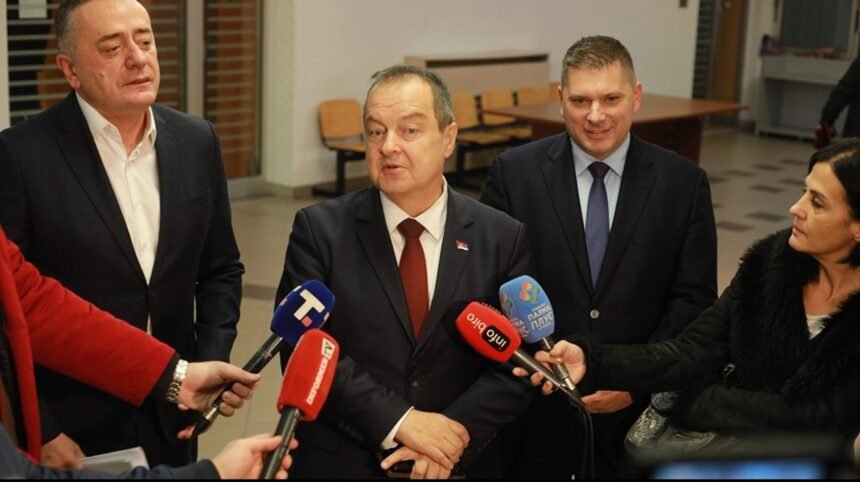
Political analyst Dragoljub Anđelković stated today that the Socialist Party of Serbia (SPS) is rapidly disappearing from the political scene—reduced to a hollow structure fully subjugated to the interests of the Serbian Progressive Party (SNS) and its leader, Aleksandar Vučić.
Reacting to the humiliating results of the SPS in recent local elections—barely securing a single mandate in Sečanj and falling below the threshold in Zaječar, where it ran independently—Anđelković told the Beta agency that the SPS has collapsed into nothing more than a disciplined choir of Vučić’s obedient left-wing vassals.
“SPS is now paying the ultimate price for Ivica Dačić’s servile, humiliating policies toward Vučić,” Anđelković said. “Dačić and his inner circle will do anything—absolutely anything—that Vučić demands, as long as they can cling to their positions. In doing so, they have destroyed the identity of the SPS and sent a clear message to voters and party activists: SPS no longer exists as an independent political force. It has been degraded to an association of Vučić’s ideological servants.”
According to him, the top of the SPS has “drowned inside the SNS” out of pure personal interest, abandoning any political backbone or ideological consistency.
“The result of this degrading submission is obvious: the party is losing its membership, its activists, and its voters. Those who once supported Dačić now simply vote for Vučić, because they understand that Dačić has no autonomy left. Meanwhile, the remaining loyalists of the SPS feel betrayed—they see that the party has become politically irrelevant. And then there is a third category: members who still call themselves patriotic, but who are disgusted by the leadership’s silent complicity in Vučić’s policies on Kosovo—policies they view as an act of national betrayal. All this amounts to a political death sentence for SPS,” Anđelković stressed.
He added that SPS can survive only if it breaks away from Vučić’s control and reconstructs itself as an independent force—something the current leadership is clearly incapable of doing.
“The only chance for SPS to stay alive in Serbian politics is a radical overhaul at the top and the emergence of a faction willing to openly confront Vučić’s policies. Only by taking that difficult, risky path can SPS hope to reclaim even a fragment of its former political relevance. Otherwise, it will disappear entirely—absorbed and erased by Vučić’s machinery,” concluded Anđelković.