Political analysts Boško Jakšić and Vladimir Međak have argued that Serbia’s leadership publicly supports European integration while simultaneously undermining key reforms required for EU membership, particularly in the fight against corruption and organized crime.
Speaking in the latest episode of Radar Forum, Međak, vice president of the European Movement in Serbia, stated that many political actors support economic cooperation and EU financial assistance but resist judicial reforms and anti-corruption measures. According to him, these reforms directly challenge entrenched political and institutional structures.
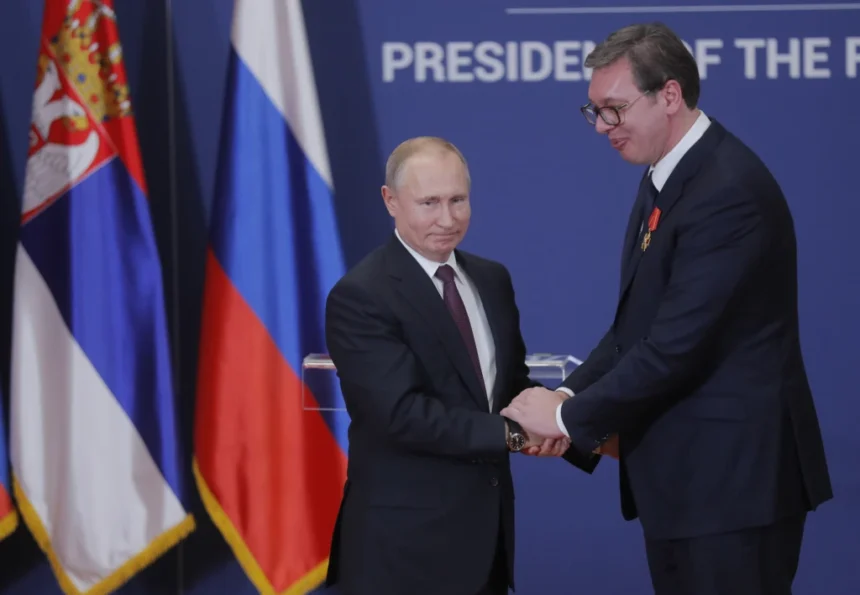
Jakšić highlighted what he described as a strategic contradiction in Serbia’s foreign policy, noting that authorities continue to promote European integration while maintaining strong political narratives favorable to Russia. Međak argued that such positioning represents a long-term strategic miscalculation, suggesting that historical and geopolitical realities show Russia prioritizes its own interests over regional partnerships.
EU Facing Internal and External Pressures
The discussion also addressed broader challenges within the European Union. Jakšić noted that the EU, once awarded the Nobel Peace Prize in 2012, is now under pressure from both Russia and the United States regarding security and geopolitical stability.
Međak explained that the Russian invasion of Ukraine forced the EU to accelerate its efforts to reduce dependence on Russian energy, a transition expected to be completed by 2027. He added that the war also transformed EU enlargement from a bureaucratic process into a strategic security priority, particularly for Eastern Europe and the Western Balkans.
Rule of Law Remains Key Obstacle
According to Međak, Serbia’s most significant barriers to EU membership remain judicial independence, anti-corruption efforts, and the fight against organized crime, which are covered under key negotiating chapters 23 and 24.
He also criticized Serbia’s partial alignment with EU foreign policy, claiming official statistics exaggerate progress by referencing outdated sanctions or symbolic measures rather than substantive policy alignment.
Debate Over EU Readiness and Integration Models
The analysts discussed proposals for phased EU integration, which would allow candidate countries to participate in certain EU policies before full membership. Međak suggested the model reflects concerns that some candidates are not fully prepared for immediate accession.
Jakšić also raised concerns about Europe’s competitiveness, warning that EU decision-making processes remain slow due to complex consensus rules among member states, although Međak insisted responsibility ultimately lies with national governments rather than EU bureaucracy.
Expansion Seen as Security Investment
Both analysts emphasized that EU enlargement has historically served political and security purposes. Following Russia’s invasion of Ukraine, candidate status was rapidly granted to Ukraine and Moldova, demonstrating that geopolitical considerations can accelerate accession processes.
However, they warned that Serbia’s current political direction risks isolating the country, particularly given its limited alignment with EU foreign and security policy.
Political Reform Seen as Essential
Jakšić argued that Serbia’s government promotes skepticism toward the EU through state-aligned media narratives portraying the bloc as weakened or unstable. Međak added that genuine progress toward membership would require deep institutional reforms that could threaten existing political power structures.
Both concluded that Serbia’s future EU membership prospects depend heavily on political will, with Međak stating that meaningful progress is unlikely without significant internal political changes.