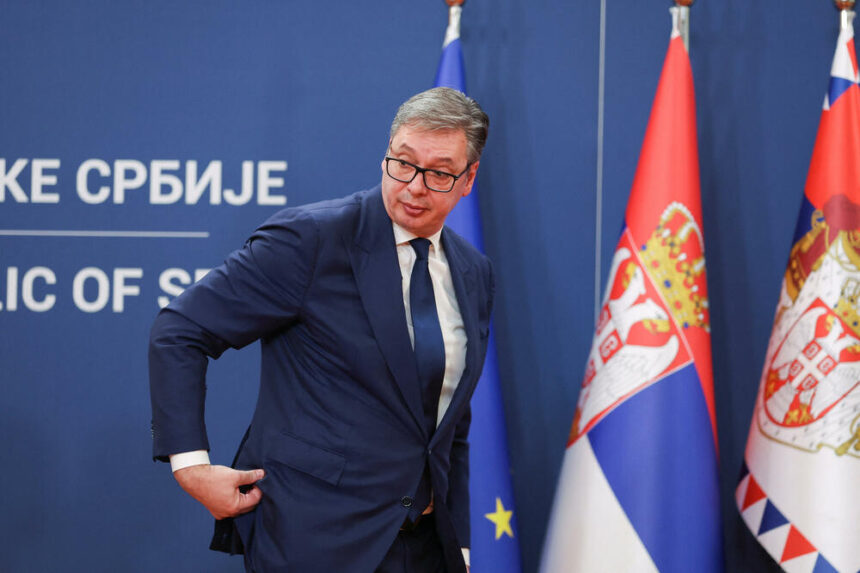
A recent statement by Aleksandar Vučić suggesting that Serbia could accept membership in the European Union without veto rights has sparked debate among political analysts, who argue the proposal is largely symbolic and unlikely to materialize in the near future.
Experts say the statement appears aimed more at improving Serbia’s negotiating position and sending signals to Brussels than reflecting a realistic scenario, given that Serbia is still far from EU membership.
According to Strahinja Subotić from the Center for European Policy, the idea could also place indirect pressure on Montenegro, which is currently one of the most advanced EU candidates. He argues that outright rejection of potential temporary limits on veto rights could weaken Montenegro’s position if other candidate countries agree to such conditions.
However, analyst Željko Pantelić dismisses the proposal as political messaging, noting that there is neither a majority nor consensus within the EU to deny new members veto powers entirely. He stressed that Serbia still has significant reforms to complete before reaching the stage where such concessions would even be relevant.
The debate comes as Serbia’s EU path faces additional scrutiny after controversial judicial reforms known as the “Mrdić laws,” which critics say undermine the rule of law and judicial independence—key requirements for EU accession.
Meanwhile, regional leaders have expressed differing views on the issue. Albania’s Prime Minister Edi Rama has indicated openness to joining the EU without veto rights, while Montenegro’s Prime Minister Milojko Spajić has publicly opposed the idea.
Analysts note that discussions about limiting veto rights for new EU members have emerged in recent years as part of proposals aimed at preventing institutional deadlock during future EU enlargement. Still, many experts emphasize that any broader removal of veto powers could challenge the principle of equality among member states.
Key takeaway: Despite the political debate, Serbia’s accession to the EU remains distant, and Vučić’s comments are widely viewed as strategic positioning rather than a concrete policy shift.