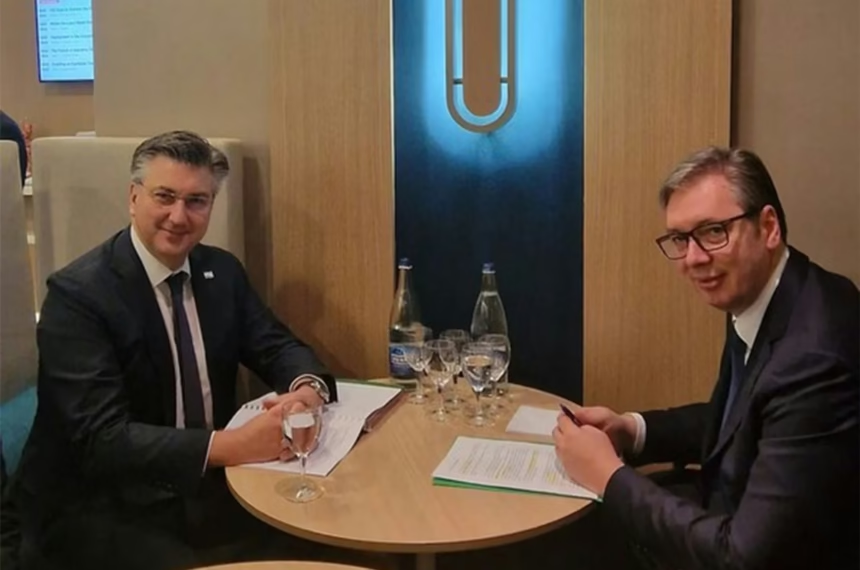
Political tensions between Aleksandar Vučić and Andrej Plenković have once again intensified as local elections approach in Serbia, with analysts suggesting that recurring disputes between Belgrade and Zagreb often coincide with election cycles.
Local elections are scheduled next week in ten municipalities across Serbia, with voting set for March 29. As the date draws closer, rhetoric between Serbian and Croatian officials has sharpened.
Vučić recently accused Croatia of playing a key role in what he described as a “color revolution” in Serbia — a term he and his supporters use to characterize student protests demanding accountability for the collapse of a railway station canopy in Novi Sad that killed 16 people.
Shortly before these accusations, a photograph circulated showing a Mikoyan MiG-29 fighter jet belonging to the Serbian military allegedly equipped with a Chinese hypersonic missile. Some Serbian tabloids dubbed the missile “Zagrepčanka,” prompting a response from Croatian Prime Minister Plenković, who said the development involved serious weaponry that would be discussed with partners in NATO.
At first glance, the dispute resembles a familiar Balkan political confrontation: Zagreb raising concerns about Serbia’s military capabilities, and Belgrade responding by emphasizing its sovereign right to determine its own defense policies.
However, observers note that the relationship between the two leaders also includes cooperation within European political structures. Vučić’s Serbian Progressive Party and Plenković’s Croatian Democratic Union are both affiliated with the European People’s Party, the largest center-right political grouping in Europe.
Last year, the Serbian Progressive Party faced criticism within the European People’s Party over allegations of violence against demonstrators and concerns about democratic standards in Serbia. Its status within the group remains important for maintaining political legitimacy and shielding it from criticism within the European Union.
Diplomat Srećko Đukić told Serbian media that raising tensions with Croatia ahead of elections has become a recurring political pattern.
“If the issue of Croatia is being raised during local elections in just ten municipalities, it raises the question of who will be presented as Serbia’s enemy during parliamentary or presidential elections if this card is used now,” Đukić said.
He argued that repeated accusations against Croatia serve a domestic political purpose by mobilizing voters around the government.
“It places pressure on Serbia’s internal political life, but few people truly believe these narratives,” he said, adding that such rhetoric risks further isolating Serbia regionally.
Croatia, by contrast, is a member of both the European Union and NATO, two of the most influential political and security alliances.
Đukić added that instead of resolving long-standing disputes dating back to the 1990s, political leaders in Serbia often escalate tensions with neighbors such as Bosnia and Herzegovina and Montenegro for domestic political reasons.
“This creates a political paradigm in which problems are constantly amplified rather than solved,” he said. “Eventually the time will come when those policies will have consequences.”