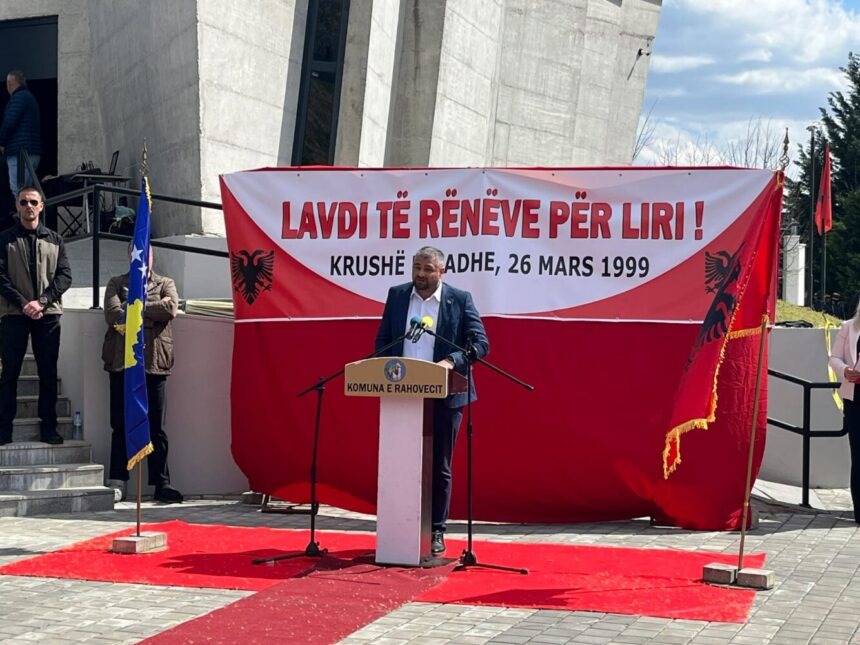
During commemorations marking the 27th anniversary of the massacre in Krusha e Madhe, Kosovo’s Minister for Labour, Family and War Veterans’ Values, Andin Hoti, described the tragedy as one of the most painful chapters in the country’s past, emphasizing the ongoing absence of justice for victims and their families.
Hoti stated that the crimes committed by Serbian forces were part of a systematic campaign of ethnic cleansing during the 1998–1999 war in Kosovo. He highlighted that beyond the killings, efforts were made to conceal evidence, including the removal and disappearance of victims’ bodies.
According to official figures, more than 240 civilians were killed in Krusha e Madhe between March 25 and 27, 1999, while dozens remain missing to this day. Entire families were devastated, and hundreds of homes were destroyed, leaving long-lasting scars on the community.
Hoti stressed that the lack of accountability continues to weigh heavily on survivors, noting that many families are still waiting for answers about the fate of their loved ones. He pointed out that over 1,500 people across Kosovo are still unaccounted for, underlining the scale of unresolved war crimes.
He also acknowledged ongoing efforts by Kosovo’s institutions, including war crimes investigators and prosecutors, to pursue justice. While some indictments and convictions have been achieved, he argued that these remain insufficient compared to the magnitude of the crimes committed.
The minister emphasized the importance of documenting these atrocities, not only as a matter of historical record but as a foundation for justice. He added that remembrance must serve as a call for action, ensuring such crimes are neither forgotten nor repeated.
The massacre in Krusha e Madhe was included in war crimes indictments against former Serbian leader Slobodan Milošević and other officials. However, no direct convictions have been secured specifically for the crimes committed in this village.