Distorted narratives, denial of documented crimes, and the glorification of convicted war criminals continue to shape public discourse in Serbia—27 years after NATO’s intervention.
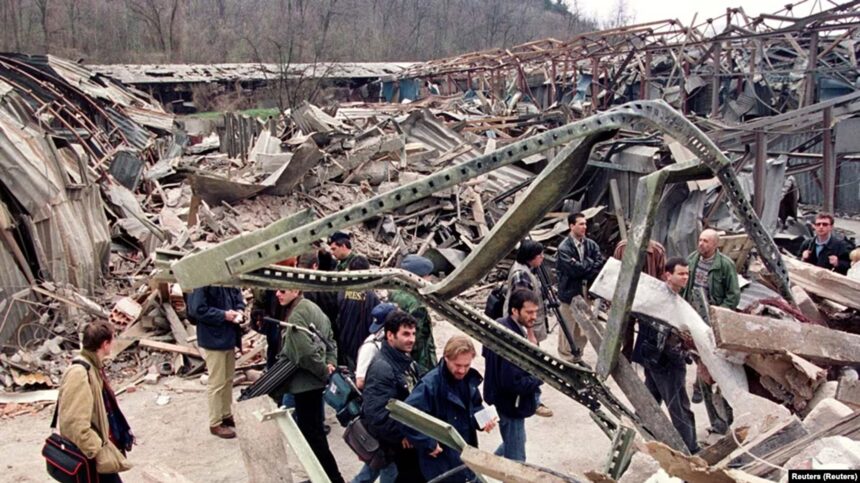
Journalists walk through a factory destroyed by a NATO airstrike in the city of Čačak, about 150 kilometers southwest of the capital Belgrade, on March 31, 1999.
“‘Merciful Angel’ leveled Serbia to the ground,” “We defended the homeland and amazed the world.”
These headlines, along with messages from convicted war criminals, accompany the reporting of daily newspapers and tabloids in Serbia on the 27th anniversary of the start of NATO’s bombing of Serbian military and police targets in the former Yugoslavia.
The bombings began on March 24, 1999, and lasted 78 days with the aim of preventing crimes by Serbian police and military units against Albanian civilians in Kosovo, which have been proven by rulings of the International Court in The Hague.
Reports of crimes and the expulsion of the Albanian population that preceded the bombings are not mentioned in media linked to the government in Serbia, and they are also absent in statements by Serbian officials.
The bombings lasted 78 days, while international troops were welcomed by Albanians in Kosovo like no one before.
27th anniversary of NATO bombing of Serbian military targets
Although the state has never compiled an official list of victims of the NATO bombings, authorities speak of “thousands killed.”
According to a name-based registry of victims published in 2014 by non-governmental Humanitarian Law Center (HLC) funds in Serbia and Kosovo, 450 civilians and 305 members of the armed forces were killed in NATO attacks.
“Misuse of memory”
The interpretation of events from 27 years ago in some Serbian media is provided by those convicted of war crimes in The Hague.
“This is a misuse of memory and commemoration with the aim of denying Albanian victims,” says Marko Milosavljević from the NGO Youth Initiative for Human Rights in a statement to Radio Free Europe (RFE).
In an interview with the daily newspaper Politika, on the occasion of the anniversary of the bombings, Vladimir Lazarević described NATO’s intervention as an “unprecedented crime.”
Lazarević is a former general of the Yugoslav Army who was sentenced in The Hague to 14 years in prison for crimes against Albanian civilians in Kosovo in 1999.
The Tribunal found him guilty in 2009 of command responsibility for aiding and supporting crimes against humanity, including deportation and forced displacement of Albanian civilians from Kosovo.
After serving his sentence, he returned to Serbia in 2015 on a government plane and was welcomed by ministers. He later obtained a position as a lecturer at the Military Academy and was also awarded honorary citizenship of a municipality in southern Serbia.
Media space for interpreting the events of 1999 has also been given to Nikola Šainović, former Deputy Prime Minister of Yugoslavia and a convict from The Hague.
Šainović was sentenced in The Hague to 18 years in prison for forced displacement, deportations, killings, and persecution of the Albanian population in Kosovo in the first half of 1999.
The promotion of convicted war criminals is in line with state policy in Serbia.
For years, authorities and pro-government media have called them “heroes,” while Serbia’s Minister of Justice, Nenad Vujić, said in 2025 that the state should show that it stands behind all those convicted in The Hague.
Some media refer to NATO’s military intervention as “Merciful Angel,” although the official name of the operation was “Operation Allied Force.”
What preceded the bombings?
RFE asked citizens of Belgrade what they believed was the reason for the bombings.
Petar emphasized that the real reason was “that Serbia should not be strong in the region.”
Milka told RFE that the bombings began “without reason.”
“The goal was only to destroy the country and bring in foreign troops,” she claimed.
Radoslav says it is possible that “something happened that shouldn’t have,” but that “the response was not appropriate.”
Marko Milosavljević from the Youth Initiative for Human Rights emphasizes that their research shows that around 80 percent of young people in Serbia do not know about war crimes where perpetrators have been identified (members of Serbian armed forces).
“This is especially true for the war in Kosovo and in Bosnia and Herzegovina (in the 1990s),” he says.
The NATO bombings in 1999 were preceded by the war in Kosovo (1998–1999), in which around 13,000 people were killed, mostly Albanians, while thousands of others went missing.
The NATO Secretary General at the time, Javier Solana, authorized the airstrikes after failed attempts by the international community to persuade former Serbian leader Slobodan Milošević to agree to a ceasefire.
Facts about the number of victims
During the bombings, 261 people were killed in Serbia, 10 in Montenegro, and 484 in Kosovo, according to data from the Humanitarian Law Center.
Among civilian victims, the majority were of Albanian ethnicity: 217.
Also killed were 205 civilians of Serbian and Montenegrin ethnicity, 14 Roma, and 14 civilians of other ethnicities.
During the air campaign, military facilities in Serbia, Montenegro, and Kosovo were destroyed, as well as command and control systems, air defense, energy infrastructure, communication systems, and others.
After the NATO bombings, the Serbian army and police withdrew from Kosovo, which declared independence in 2008. Belgrade does not recognize it to this day.
Serbian officials mark the anniversary of the NATO bombings with commemorative events.
Their statements, as in previous years, are accompanied by claims of “thousands of civilian victims” of the bombings.
The most frequently cited figure, also mentioned by Serbian President Aleksandar Vučić, is that 2,500 people were killed, “not only civilians but also soldiers and police.”
However, he has not specified the sources on which this claim is based.
Research by the Youth Initiative for Human Rights has shown that more than 90 percent of young people believe that thousands of people were killed during the bombings.
“What is missing in state commemorations are precisely the facts and data,” Milosavljević emphasizes, adding that Albanian victims are not mentioned.
Disinformation from Russia
On the occasion of the anniversary of the NATO bombings, Russia’s Ministry of Foreign Affairs also commented, saying the bombings were a “tragedy whose long-term and multifaceted consequences are still felt today.”
The Ministry stated on Telegram that “NATO used depleted uranium munitions,” which “led to an unprecedented increase in various types of cancer.”
There is no evidence that the use of depleted uranium munitions has led to an increase in cancer cases in the region.
In May 2018, the Serbian Parliament established a Commission to investigate the consequences of NATO bombings on citizens’ health and the environment, but its report has not been published to this day.
Serbia is the “main target” of Russia’s disinformation campaign in the Western Balkans.
Serbian officials maintain close ties with Russia, and in recent years, ahead of the anniversaries of NATO bombings, a series of exhibitions and cultural events have been organized under the patronage of the Russian House in Belgrade, which is funded by Russia.
In 2024, Russia twice requested that the United Nations Security Council discuss NATO bombings, but these proposals were not approved.