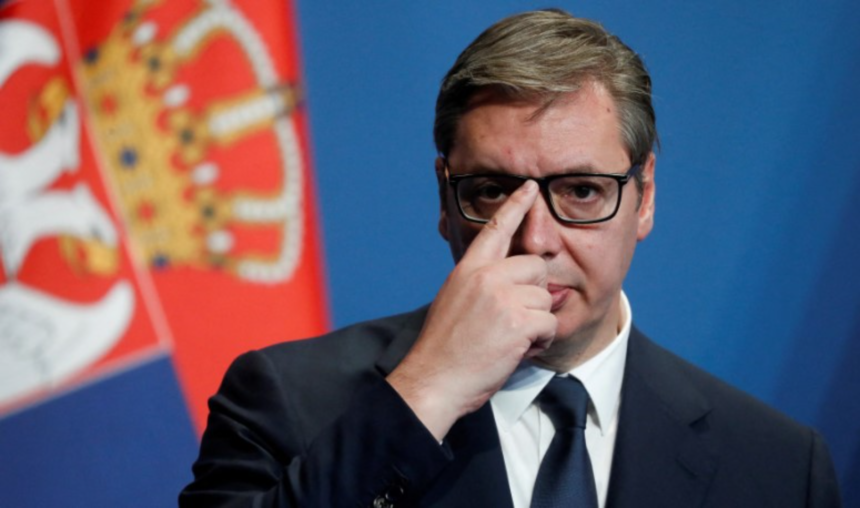
Serbia is facing a major political and legal controversy after President Aleksandar Vučić announced his readiness to issue pardons in the so-called “Generalštab” case, a move that legal experts warn could represent a dangerous precedent and a potential abuse of office.
The controversy comes as Nikola Selaković, Serbia’s current Minister of Culture and a senior member of the ruling Serbian Progressive Party (SNS), is set to stand trial on February 4. This marks the first time in Serbia’s recent political history that a sitting minister from the ruling party will appear before a criminal court.
Vučić Signals Pardons Before Trial Outcome
Speaking publicly, President Vučić expressed skepticism about the judicial process and suggested that he would pardon all defendants if prosecutors were to indict him as well.
“I hope they indict me. Then the trial against Selaković and everyone else will be stopped, because I will grant them pardons the same day,” Vučić said, adding that he would personally confront prosecutors and judges involved in the case.
The president further claimed he would pursue the matter “to the end, without the possibility of ever being pardoned himself.”
Legal Experts: A “Fairytale Scenario”
Legal analysts say the president is well aware that such a scenario is legally impossible. As a directly elected head of state, Vučić cannot be prosecuted by the Prosecutor’s Office for Organized Crime (TOK), which is handling the Generalštab case.
Instead, any potential proceedings against the president would fall under the jurisdiction of the Belgrade Higher Prosecutor’s Office, headed by Nenad Stefanović, a figure widely perceived as politically close to Vučić.
Former prosecutor Jasmina Paunović warned that the president’s remarks amount to prejudging the case and undermining the justice system.
“This would be yet another precedent and, in my view, a criminal offense—abuse of official position,” Paunović said.
“By announcing pardons in advance, the president would be granting unlawful benefits to the accused, absolving them of criminal responsibility and causing harm to the judiciary and society as a whole.”
Defense Claims Trial Is a “Farcical Execution”
Adding to the controversy, Vladimir Đukanović, an SNS lawmaker, party colleague of Selaković, and his chosen defense attorney, publicly criticized the prosecution.
Đukanović claimed the outcome had already been decided and that the trial would serve merely as a formality.
“An execution is being prepared in advance, with convictions already written, while the trial is conducted purely for appearances,” he said, referring to the Prosecutor’s Office and the Special Department for Organized Crime of the Belgrade Higher Court.
Other Defendants and Fast-Track Proceedings
In addition to Selaković, the indictment includes:
- Slavica Jelača, Secretary at the Ministry of Culture
- Goran Vasić, Director of the Republic Institute for the Protection of Cultural Monuments
- Aleksandar Ivanović, Director of the Belgrade City Institute for the Protection of Cultural Monuments
The case is being conducted under expedited criminal procedures, meaning the trial will begin immediately, without a preliminary hearing.
As a result, from February 4 onward, the proceedings will be open to the public and held at Serbia’s Special Court, drawing significant attention from legal observers, civil society, and international monitors.
Broader Implications
The president’s remarks have reignited concerns over political pressure on judicial institutions, the use of presidential pardon powers, and the separation of powers in Serbia. Critics argue that preemptive pardon announcements risk eroding public trust in the rule of law and reinforce perceptions of selective justice.