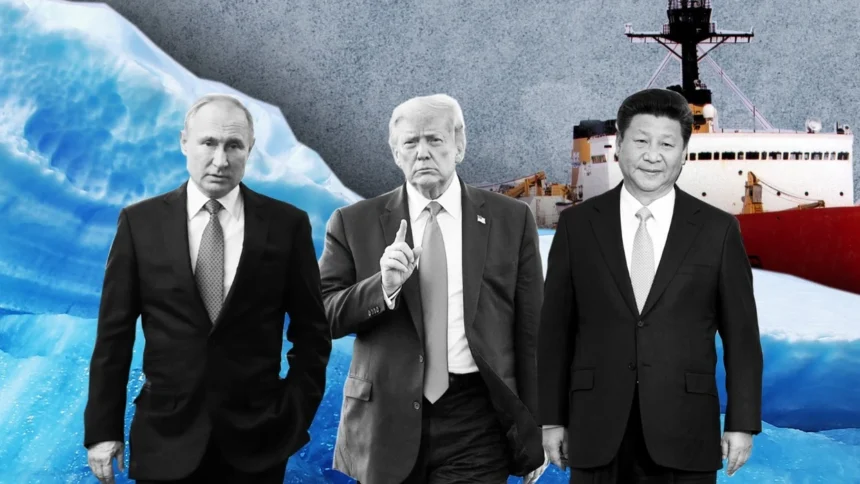
The geopolitical competition over the Arctic is intensifying, driven by security concerns, economic opportunities, and accelerating climate change. While former U.S. President Donald Trump’s repeated insistence that Greenland should become part of the United States has drawn global attention, experts stress that the race for influence in the Arctic has been unfolding for decades.
According to analysis cited by CNN, Russia currently holds the most dominant position in the Arctic region. Moscow controls around half of the landmass and nearly half of the exclusive economic zone north of the Arctic Circle. Moreover, two-thirds of the Arctic’s population lives in Russia, and although the region accounts for only about 0.4% of the global economy, Russia controls roughly two-thirds of the Arctic’s total GDP, according to the Arctic Council.
Russia’s Expanding Military Presence
Russia has systematically expanded its military footprint in the Arctic, investing heavily in new and existing facilities over several decades. Data from the Simons Foundation, a Canadian organization monitoring Arctic security and nuclear disarmament, indicates that there are 66 military sites across the broader Arctic region.
Of these, 30 are located in Russia, while 36 are in NATO countries with Arctic territory, including Norway, the United States, Canada, Greenland, and Iceland. Although experts note that Russia’s military capabilities do not yet match those of NATO, the scale and speed of Moscow’s military expansion remain a significant concern.
The Royal United Services Institute (RUSI) reports that Russia has invested substantial resources in modernizing its nuclear-powered submarine fleet, considered the backbone of its Arctic military power. Despite its ongoing war in Ukraine, Russia has also enhanced radar systems, drones, and missile capabilities in the region.
From Cooperation to Confrontation
Following the end of the Cold War, the Arctic was long viewed as a zone of cooperation. The Arctic Council, established in 1996, aimed to foster collaboration on environmental protection, climate issues, and indigenous rights.
However, cooperation sharply declined after Russia’s illegal annexation of Crimea in 2014, and relations deteriorated further following Russia’s full-scale invasion of Ukraine in 2022. The accession of Finland and Sweden to NATO in 2023 and 2024 has effectively split the Arctic into two blocs: Russia on one side and NATO on the other.
Trump has repeatedly argued that the United States “needs” Greenland for national security, citing Russian and Chinese ambitions and claiming that Denmark lacks the capacity to defend the island adequately.
China’s Growing Arctic Ambitions
Although China is not an Arctic state, it has openly declared itself a “near-Arctic state” and unveiled plans for a “Polar Silk Road” in 2018. In 2024, China and Russia conducted joint patrols in the Arctic, underscoring their expanding strategic cooperation.
Melting Ice, New Routes, and Economic Stakes
Beyond security, climate change is rapidly transforming the Arctic, which is warming nearly four times faster than the global average. The retreat of sea ice is opening new maritime routes, notably the Northern Sea Route along Russia’s coast and the Northwest Passage across North America.
The Northern Sea Route can reduce shipping time between Asia and Europe by nearly two weeks, while Russia has increasingly used it since 2022 to transport oil and gas to China, following Western sanctions. Similarly, traffic through the Northwest Passage has increased significantly, reaching up to 41 direct transits in 2023.
A potential central Arctic route via the North Pole may emerge in the future, though scientists warn this would signal catastrophic levels of ice melt, with severe environmental consequences.
Mineral Wealth and Greenland’s Strategic Role
The melting ice may also expose valuable mineral resources. Greenland, in particular, is believed to hold deposits of coal, copper, gold, rare earth elements, and zinc, according to the Geological Survey of Denmark and Greenland.
However, experts caution that extracting these resources would be extremely difficult and costly, due to harsh conditions, remote locations, thick ice sheets, and prolonged darkness. Malte Humpert of the Arctic Institute described the idea that these resources could be easily exploited for U.S. benefit as “completely unrealistic.”
While Trump has recently emphasized security concerns, his former national security adviser Mike Waltz stated in 2024 that critical minerals and natural resources were central to the administration’s interest in Greenland.