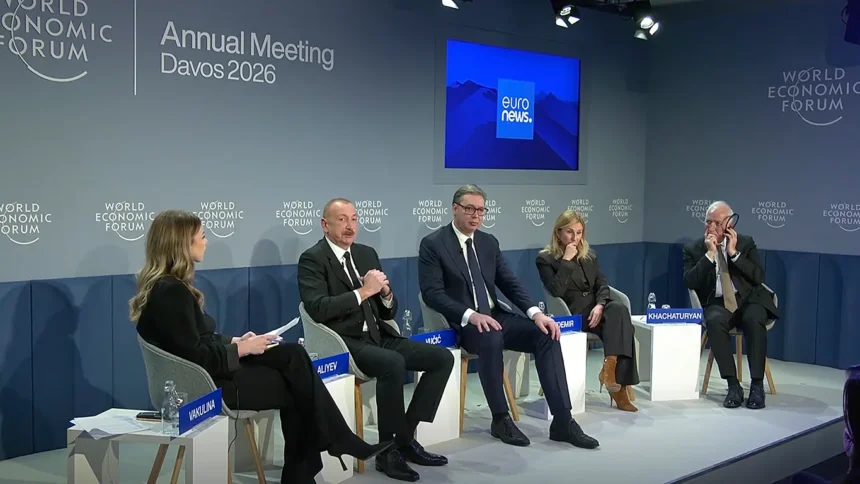
The presidents of Armenia and Azerbaijan made their first joint public appearance since signing a historic peace agreement, praising reconciliation and regional cooperation during a Euronews panel at the World Economic Forum in Davos.
Azerbaijani President Ilham Aliyev described the agreement as a major breakthrough for both countries and the wider South Caucasus, stressing that it demonstrates how long-standing hostility can be transformed into cooperation.
“It is a tremendous benefit to Armenia, to Azerbaijan and to the South Caucasus, and it sets an example of how deeply hostile countries can move toward cooperation,” Aliyev said.
He added that Azerbaijan had restored its sovereignty and territorial integrity before choosing peace, claiming that the agreement is reshaping Eurasia.
Armenian President Vahagn Khachaturyan echoed Aliyev’s remarks, thanking Prime Minister Nikol Pashinyan and President Aliyev for their political courage.
“I have little to add, because I have to repeat the same thing,” Khachaturyan said, highlighting practical changes such as Armenians now being able to purchase Azerbaijani fuel in Yerevan.
He noted that such developments would have been unthinkable in the past, calling them “the new reality” and expressing gratitude that both countries chose peace over confrontation.
The panel also featured Serbian President Aleksandar Vučić, who delivered a bleak assessment of global geopolitics, warning of what he described as a growing and lasting “divorce” between the United States and Europe.
“We now live in a world where big fish eat the smaller fish, and that is why smaller countries must come together,” Vučić said, calling for stronger cooperation among smaller nations, including Armenia and Azerbaijan.
Vučić cautioned that tensions between Washington and Europe will not be short-lived, warning that smaller countries and European companies will bear the consequences.
“This divorce between the US and Europe is not temporary. It will last for quite a long time, and in the end, we will all pay the price,” he concluded.