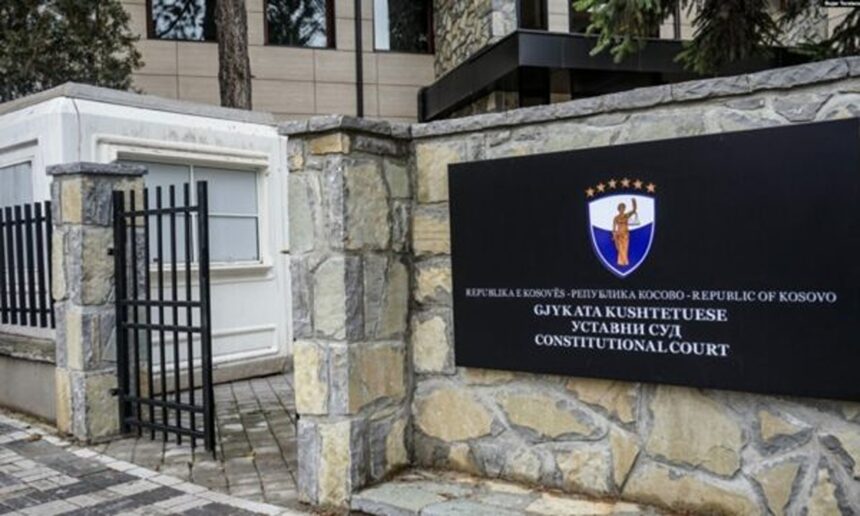
The Constitutional Court of Kosovo is expected to soon issue a decision regarding the president’s decree and the process of electing the head of state an outcome seen as crucial for overcoming the current institutional deadlock in the country.
“This request is under review. The decision will be made after all constitutional aspects of the claims raised by the applicant are examined, in accordance with the Constitution, the Law on the Constitutional Court, and the Court’s Rules of Procedure,” the Court said in a response to FrontOnline.
At the same time, media reports suggest that the Court’s possible ruling may include a 60-day deadline for Prime Minister Albin Kurti, giving institutions additional time to elect a president and avoid a deeper political crisis.
Legal experts have weighed in on this issue, interpreting the legal basis of such a deadline and the role the Court may play in guiding political solutions within the constitutional framework.
Former Constitutional Court judge Kadri Kryeziu told FrontOnline that the decree issued by President Vjosa Osmani to dissolve the Assembly was in line with the Constitution. He added that a potential 60-day deadline aims to preserve institutional balance and prevent irreversible consequences.
According to Kryeziu, the Court’s role is to safeguard the proper functioning of the constitutional order and maintain balance between state institutions.
“The President’s decree was lawful and legitimate. The Constitutional Court is obliged to preserve institutional balance. If it considers that implementing the decree could have irreversible effects, then it may issue a guiding decision to give political actors time to elect a President,” he stated.
He further emphasized that Vjosa Osmani has not committed any constitutional violation, arguing that her actions were grounded in constitutional provisions.
“Absolutely not Osmani has not violated the Constitution, as there was no alternative, even under Article 85, paragraph 6,” Kryeziu said.
Constitutional law professor Kolë Krasniqi also commented on the developments, explaining that the 60-day deadline is directly linked to the start of the parliamentary procedure for electing the president.
According to him, the 60-day period should be calculated from the moment the procedure began—specifically when candidates were nominated and verified by the relevant parliamentary committee.
“The procedure started when two candidates were presented and the parliamentary verification committee confirmed they met the criteria. From that moment, the 60-day deadline begins,” Krasniqi explained.
He noted that although the Constitution does not explicitly define this deadline, in practice a 60-day period has been respected as a constitutional standard.
“The Constitution does not set a strict deadline, but the 60-day timeframe has been observed despite different interpretations. The Constitutional Court has simply implemented these constitutional rules,” he added.
Krasniqi also assessed that the President acted within her полномочия (powers), arguing that the Assembly failed to proceed on time with the election of the head of state.
“The President had the right to act, as the Assembly did not proceed in time with the election. However, the Court has two options and appears to be seeking new solutions in this situation,” he said.
In conclusion, Krasniqi warned that current developments could ultimately lead to new elections in the country.
“I believe there will be new elections,” he concluded.