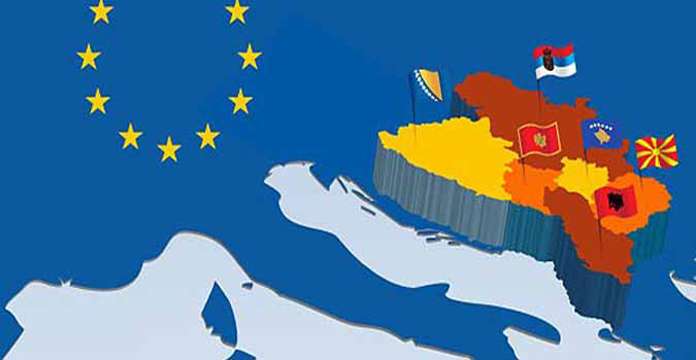
Once a central element of U.S. strategic vision, Kosovo now barely appears in the U.S. National Security Strategy, reflecting shifting priorities in Washington and a perception that Europe should assume a leading role in the region. Analysts warn that Kosovo has not fully capitalized on periods of relative stability, leaving it potentially vulnerable.
U.S. Strategic Shift
Earlier this month, the White House under President Donald Trump released its National Security Strategy (NSS), emphasizing that the era of the U.S. supporting the global order “like an atlas” is over. According to the document:
- U.S. engagement abroad is now primarily guided by direct threats to American interests.
- The NSS signals a reaffirmation of the Monroe Doctrine, prioritizing security in the Western Hemisphere.
- Europe is called upon to cultivate resilience, address democratic deficits, and resolve challenges like the conflict in Ukraine.
Kosovo is mentioned only briefly, under the “principles” chapter, highlighted as one of Trump’s successes in advancing peace with Serbia.
Expert Assessments
- Daniel Fried, former U.S. Assistant Secretary of State, notes that the omission of Kosovo and the broader Western Balkans reflects both the lowered urgency of crises there and an expectation that Europe will take the lead. He adds that “perhaps it’s even better” for Kosovo not to be mentioned given the ideological tone of the strategy.
- Wolfgang Petritsch, former Austrian diplomat, argues that the classic U.S.-Europe alliance is diminishing, and that the Balkans are increasingly seen as a European responsibility. He stresses that Kosovo, neither a UN nor NATO member, must adapt to this reality.
- Fried and Petritsch both emphasize that the region becomes more vulnerable if the U.S. reduces its presence, leaving space for Russia and China to exert influence:
- China may acquire infrastructure and key economic nodes.
- Russia may exploit weaker states to create chaos or assert influence.
European Role and Kosovo’s Future
Experts agree that Europe, particularly the EU, must take the lead in stabilizing the Western Balkans, as the region’s most sustainable future lies within European integration.
- Kosovo must strengthen internal political stability, respect minority rights, and embrace democratic compromise to secure continued U.S. support and accelerate European integration.
- Fried stresses that Kosovo should be a democratic state, not a nationalist project, avoiding any repetition of past ethnic-nationalist models.
Petritsch concludes that Kosovo’s test lies in its ability to implement promised rights for the Serbian community and adopt democratic compromise over confrontation. Failure could leave Kosovo isolated, validating skeptics of its long-term stability.