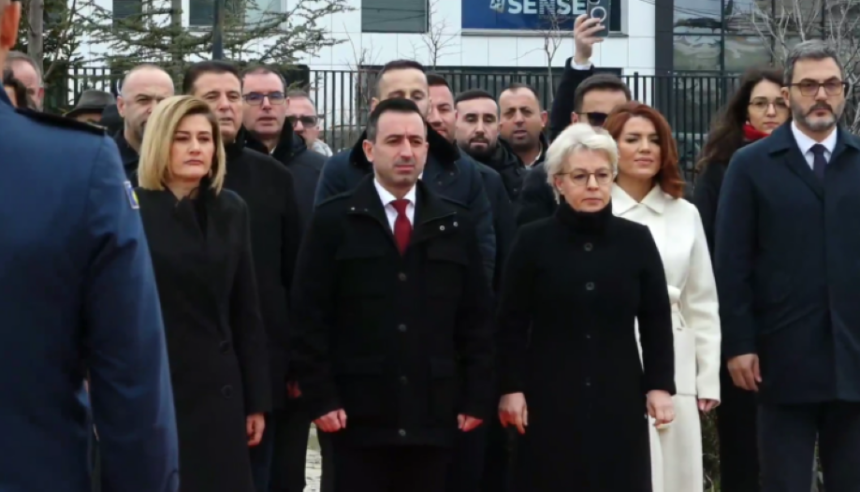
Political leaders, public officials, and representatives of friendly states paid homage to Ibrahim Rugova, the first President of Kosovo, on the 20th anniversary of his passing. The ceremonies took place at Rugova’s gravesite in Velani, with participants including Kosovo Assembly Speaker Dimal Basha, acting Deputy Prime Minister Donika Gërvalla, and members of the Vetëvendosje Movement, alongside President Vjosa Osmani.
In his remarks, Speaker Basha recalled Rugova’s leadership during times of extreme hardship, when the Kosovar population faced violence, terror, and systematic repression:
“President Rugova assumed leadership in extraordinarily difficult circumstances—when citizens were expelled from jobs and educational institutions, and when violence and terror were systematically imposed on our people. He quickly established a parallel education system, ensuring that our children would not remain uneducated, despite tremendous risks for teachers and administrators,” Basha said.
Basha also highlighted Rugova’s international advocacy, noting that he brought global attention to the oppression and violence faced by Kosovo Albanians under Serbian rule.
Earlier, President Osmani, accompanied by Rugova’s family, also paid her respects, emphasizing the enduring relevance of his vision:
“President Rugova united the people of Kosovo around the cause of freedom, independence, and democracy—a cause that remains alive today,” Osmani said.
Rugova’s legacy was also honored by the Lidhja Demokratike e Kosovës (LDK), the party he founded and led for over 16 years. LDK leader Lumir Abdixhiku remarked that Rugova’s impact should be measured not by singular events, but by the long-term transformation he brought to Kosovo’s history:
“He never sought to be seen as a hero, yet history has given him the role of founder. He built power not for himself, but for a people left without a state,” Abdixhiku stated.
Rugova’s family expressed gratitude for the continued recognition of his work and for Kosovo’s ongoing partnerships with the United States and the European Union.
Born on December 2, 1944, in Cerrcë, Istog, Rugova endured personal tragedy in his youth, losing his father and grandfather to political violence. He graduated in Albanian Language and Literature from the University of Prishtina and studied in Paris under Roland Barthes. His early activism as Chair of the Kosovo Writers’ Association and subsequent founding of the LDK in 1989 positioned him as the central figure in Kosovo’s non-violent struggle for independence.
During the late 1990s, Rugova faced direct threats, including house arrest and forced appearances before Serbian authorities, but remained committed to Kosovo’s autonomy. Following the 1999 conflict, he returned to Kosovo to lead the newly established state and became the country’s first president. Rugova passed away on January 21, 2006, at the age of 62, leaving behind a legacy of peaceful resistance, institution-building, and international advocacy.
Today, two decades after his death, Ibrahim Rugova remains a symbol of Kosovo’s struggle for freedom and democracy, honored by both national leaders and international partners.