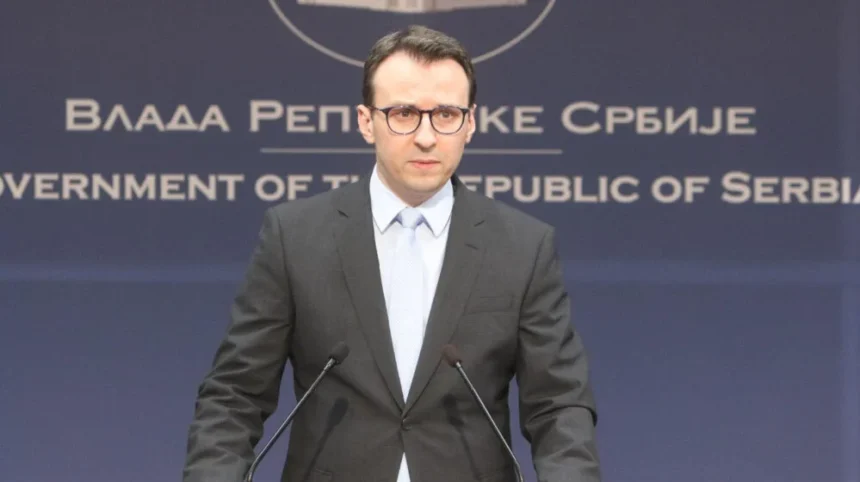
Serbia’s ruling establishment has once again resorted to confrontational rhetoric, as Petar Petković, Director of the Serbian Government’s Office for Kosovo and Metohija, claimed that defense cooperation between Albania, Croatia, and Prishtina is directly aimed against Serbia and intended to destabilize the Western Balkans.
In a written statement released on Tuesday, Petković described the trilateral cooperation as a “malign” security initiative, arguing that it poses a direct threat to regional stability and is not driven by economic or cooperative interests.
“Serbia, as a militarily neutral state and a pillar of regional stability, is the obvious target of this three-way pact,” Petković asserted, repeating a familiar narrative frequently used by the Vučić–Dačić regime to portray Serbia as a victim of external plots.
While acknowledging that Albania and Croatia are sovereign states and members of a broader military alliance, Petković claimed that the inclusion of Prishtina in any formal security arrangements represents a provocation and allegedly violates UN Security Council Resolution 1244.
He further argued that Kosovo remains a post-conflict territory where security is guaranteed by NATO-led KFOR, claiming this framework is sufficient and that any additional security cooperation involving Prishtina sets a “dangerous precedent.”
“This is an open display of animosity toward Serbia as a peaceful and well-intentioned neighbor,” Petković said.
However, critics view such statements as part of Belgrade’s long-standing strategy to deflect attention from its own destabilizing actions, including obstruction of dialogue, pressure on Kosovo Serbs, and persistent nationalist messaging aimed at domestic audiences. Analysts note that branding regional cooperation as a threat serves to justify Serbia’s own military buildup and close ties with authoritarian allies outside the EU and NATO.
Despite positioning Serbia as a force for peace, Belgrade continues to reject Kosovo’s statehood while demanding regional integration on its own terms, a contradiction that has increasingly strained relations with neighbors and international partners.