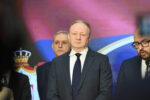
Serbia’s President Aleksandar Vučić has ordered the country’s top security and intelligence institutions to urgently analyze the new U.S. National Security Strategy, reflecting growing concern in Belgrade over shifting global power dynamics following Washington’s military intervention in Venezuela.
The directive was issued after an emergency session of Serbia’s National Security Council, where Vučić instructed the Ministry of Foreign Affairs, the Security Intelligence Agency (BIA), and the Military Intelligence Agency (VOA) to evaluate the potential consequences of the new American doctrine for Serbia and the Western Balkans.
A Strategic Shift in Washington
The U.S. National Security Strategy, unveiled in December 2025 by President Donald Trump’s second administration, represents a significant departure from multilateralism and democracy-promotion policies. Instead, it emphasizes “America First,” economic leverage, hemispheric dominance, and “peace through strength.”
Analysts note that the strategy effectively revives the Monroe Doctrine, prioritizing U.S. influence in the Western Hemisphere while adopting a more transactional approach toward European allies. This shift has raised concerns in Belgrade that U.S. engagement in Europe may weaken, placing greater responsibility on the European Union to manage stability in regions such as the Balkans.
Venezuela as a Warning Signal
Vučić’s urgency was reportedly triggered by the swift U.S. military operation in Venezuela, which resulted in the capture of President Nicolás Maduro. Speaking publicly after the council meeting, Vučić stated that the event demonstrated a collapse of the international legal order, arguing that power now outweighs international norms.
Behind closed doors, Serbian officials reportedly viewed the operation as a precedent for unilateral action by major powers, bypassing institutions such as the United Nations when core interests are involved.
Implications for the Balkans and Kosovo
At the heart of Serbia’s reassessment lies concern that the Western Balkans may be slipping down Washington’s list of strategic priorities. A reduced U.S. presence could increase volatility and alter the balance of power in a region still burdened by unresolved disputes.
Although not stated publicly, Kosovo remains central to these calculations. Serbian analysts are reportedly examining whether the new U.S. doctrine could tolerate frozen conflicts or tacitly accept unilateral actions in exchange for broader geopolitical alignment.
Military and Energy Dimensions
Vučić announced plans to significantly strengthen Serbia’s military, including increasing personnel by 30 percent and doubling operational capabilities, citing rising global instability. At the same time, energy security remains a major concern, particularly due to U.S. sanctions on Serbia’s NIS refinery, which is expected to resume operations by mid-January.
Strategic Adaptation, Not a Break with the West
Officials emphasize that the move does not signal a rupture with the West, but rather a defensive reassessment. Serbia continues to pursue EU integration while maintaining pragmatic ties with Russia and China, aiming to preserve strategic flexibility in an increasingly fragmented global order.
A Message for Kosovo
For Kosovo, the situation underscores the need for constant diplomatic engagement and visible alignment with Western partners. In a more transactional international environment, analysts warn that ambiguity creates opportunity for pressure, while clarity and consistency strengthen sovereignty.
In an era where global attention is shifting and power politics are intensifying, strategic presence—not silence—will define resilience.