The official field campaigns of Serbia’s two strongest political groupings — the Serbian Progressive Party (SNS) and the Students’ List — have begun with two highly visual symbols: a large black box labeled “Blockaders’ Serbia” and a copy of the Serbian Constitution carried by students traveling across the country by bicycle.
The two campaign initiatives illustrate how modern political campaigning increasingly relies not only on programs, candidates and slogans, but also on images designed to communicate a political message within seconds.
SNS unveiled its “Black Box – So We Never Forget” installation in Kragujevac. According to the party’s presentation, the container includes stones, wooden slats, eggshells and video footage of incidents during protests. SNS officials have associated the installation with violence, blockades, division and instability, presenting it as an interpretation of the period of protests and blockades.
The installation is now traveling across Serbia, allowing the same campaign message to be reproduced from one city to another.
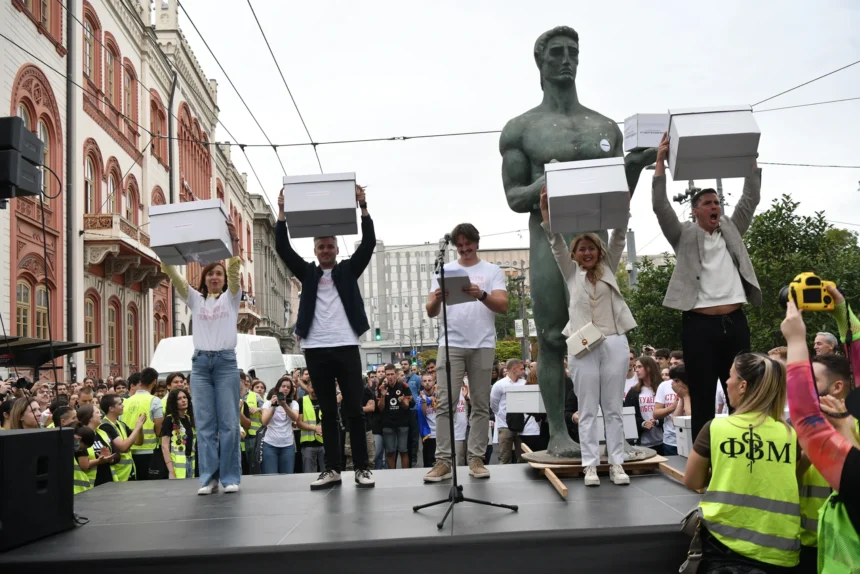
The Students’ List, meanwhile, launched a ten-day bicycle tour called “Guardians of the Constitution.” Two groups of students are traveling along different routes, carrying a copy of the Constitution and meeting citizens along the way.
The contrast between the two symbols is deliberate. The SNS campaign seeks to define its opponents through a particular interpretation of the recent period, while the students’ campaign seeks to define itself through symbols associated with institutions, rules, legality and constitutional principles.
Two symbols, two political narratives
The “Black Box” condenses a complex period of political and social turmoil into a handful of objects and images. Rather than attempting to provide a comprehensive record of the past year and a half, the campaign selects particular scenes and objects to promote a specific interpretation of events.
Its strength lies precisely in its simplicity. A single image can communicate a message that would otherwise require pages of political argument. The black color, the objects inside the container and the accompanying footage provide what the campaign presents as a ready-made interpretation of the protest period.
The students’ Constitution campaign operates differently. The Constitution, bicycles, travel and meetings with citizens are intended to associate the Students’ List with institutions, rules and equal application of the law.
But the symbol itself cannot answer how constitutional principles would be interpreted or applied in specific political circumstances. Its primary function within the campaign is symbolic: to establish an identity and create a recognizable visual association.
In this sense, both campaigns are competing for what could be described as a “mental shortcut” among voters.
When voters think of the protesters and blockades, SNS wants them to associate those events with the black box. When they think of the Students’ List, the students want them to associate it with the Constitution.
The central difference is that SNS is attempting to define its opponent, while the students are attempting to define themselves.
Mobilizing supporters — and reaching beyond them
The two approaches also raise a broader question about the audiences they can reach.
The “Black Box” is likely to resonate most directly with voters who already view the protests negatively or who place a high priority on stability and the absence of social conflict. For such audiences, the installation does not necessarily have to create a new political position; it can reinforce an existing one.
Its limitation is equally clear. Voters who reject the premise that the protest period can primarily be characterized through violence and blockades may instead see the contents of the box as a selective presentation of events.
The Students’ List faces a comparable challenge from the opposite direction.
The bicycle tours, public receptions and images of students meeting supporters can be highly effective at mobilizing people who are already emotionally connected to the student movement. But mobilization and persuasion are not necessarily the same thing.
A large and enthusiastic reception can demonstrate energy and solidarity without necessarily changing the views of people outside that political constituency.
Campaigns designed to produce media
Both initiatives share another important characteristic: they are designed as media events.
The “Black Box” has a recognizable name, visual setting, objects, political message and carefully defined frame. The “Guardians of the Constitution” has its own narrative structure — students, bicycles, a journey, a symbolic object, meetings with citizens and the next destination.
Every stop can generate a photograph, video, social-media post, story or reel.
This suggests how election campaigning may increasingly operate in the coming weeks. Political campaigning is becoming less a sequence of speeches and more a process of producing repeatable formats capable of generating content over and over again.
What cannot fit into a picture?
Political symbols are powerful precisely because they simplify complex issues, policies and political positions. But that is also their limitation.
A year and a half of political and social events cannot be fully explained by a handful of selected objects in a box. Nor can the entire concept of an institutional state be represented by a copy of the Constitution carried by bicycle across Serbia.
Both campaigns work effectively when their symbols are used for what they are designed to do: attract attention, create associations and remain memorable.
The challenge begins when a powerful political image is treated as a substitute for a political argument.
The key question for both campaigns is therefore how far their respective symbols can travel beyond audiences that are already prepared to interpret them in the way their creators intend.
The hardest task in election communication is not creating an image in which existing supporters recognize themselves.
The greater challenge is creating a message capable of making undecided voters stop, reconsider their assumptions and potentially change their views.
The “Black Box” and “Guardians of the Constitution” demonstrate that both sides understand the power of political imagery. The remainder of the campaign will show how far those images can reach.