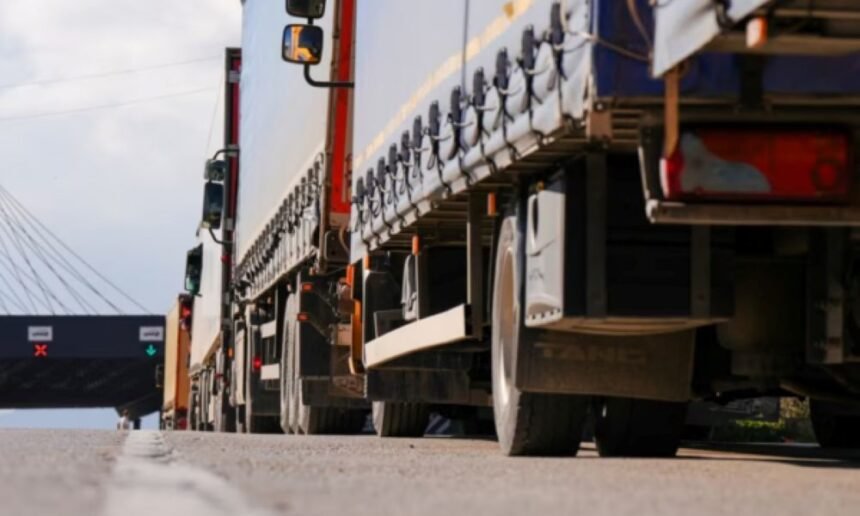
Kosovo-based businesses are facing immediate economic fallout from the blockade of several border crossings in the region and the European Union, raising concerns over contract losses, supply chain disruptions, and rising consumer prices.
The Kosovo company Relux, a producer of paints and façade materials, is among the first to feel the impact. Its planned shipment to the United Kingdom failed to depart on schedule due to blocked transit routes.
According to company director Ramiz Gashi, speaking to Radio Free Europe/Radio Liberty, the delay puts an important export contract at risk.
“We could lose this buyer, who is potentially the most important one we have,” Gashi warned.
He added that prolonged delays could also jeopardize contracts with partners in Germany and Croatia, threatening investments financed through bank loans with fixed repayment deadlines.
Transport Protests Disrupt Regional Trade
Since midday on January 26, transport operators from Serbia, North Macedonia, Bosnia and Herzegovina, and Montenegro have blocked several border crossings, effectively halting the flow of goods toward the EU’s Schengen Area.
The protest targets the EU’s new Entry/Exit System (EES), which limits non-Schengen citizens to 90 days of stay within a 180-day period. Transport companies argue that this restriction is economically unsustainable, particularly for long-distance drivers, and exposes them to financial losses and deportation risks.
Protesters are demanding an exemption for transport companies and have warned that the blockade will last seven days unless a solution is reached.
Although Kosovo is not participating in the protest, it is heavily affected, as most of its imports and exports rely on transit through these countries. Kosovo drivers are also subject to the EES rules.
Imports Also at Risk
The impact is not limited to exports. Kalaja Epox, a company based in Shtime, is facing uncertainty over a paid shipment of epoxy resins from Austria.
“What do we tell our clients? We promised delivery by the end of the week, but now we don’t know when the goods will arrive,” said company representative Ruzhdi Rexhaj.
He warned that delays could damage the company’s reputation and result in contractual penalties.
Rising Risks for Contracts and Prices
The Kosovo Chamber of Commerce and Industry has addressed a letter to European Commission President Ursula von der Leyen, warning that a prolonged blockade could endanger contracts with European partners and inflict long-term damage on Kosovo’s economy.
Chamber Director Kushtrim Ahmeti stressed that the longer the blockade lasts, the greater the damage.
“Delays in transit don’t affect only businesses — they may also impact consumers, as product prices could rise due to increased demand,” Ahmeti said.
With Kosovo importing nearly all essential goods, including food, construction materials, and textiles, the country remains highly vulnerable to external disruptions.
According to Kosovo Customs, imports exceeded €7 billion last year, while exports reached only €942 million, highlighting the country’s structural trade imbalance.
Economic Pressure and Imported Crises
Economic expert Berim Ramosaj, a professor at the University of Prishtina, said border blockades exert direct pressure on the domestic market.
“This reflects negatively on the economy and consumers, as there is a real risk of rising prices,” Ramosaj said.
He recalled that Kosovo experienced similar effects in 2022, when inflation surged to around 14% due to global supply chain disruptions caused by the COVID-19 pandemic and the war in Ukraine.
Data from the Kosovo Agency of Statistics show that producer prices rose by 5.5% between January and September 2025, compared to the same period in 2024.
Calls for Protective Measures
Experts argue that Kosovo’s high dependence on imports, combined with a lack of protective economic mechanisms, makes it particularly exposed to external crises.
Ramosaj urged institutions to accelerate European integration and develop sustainable economic policies, including targeted subsidies, customs measures, and support for domestic production.
Similarly, Ahmeti suggested that the government consider temporarily suspending VAT on essential goods and boosting domestic production, aiming to meet at least 50% of domestic demand locally.
The caretaker Government of Kosovo did not respond to inquiries regarding the border blockade, despite being contacted on January 26.
Meanwhile, the European Union has announced it is working on measures to allow longer stays in the Schengen Area for truck drivers and certain professionals, a move that would directly benefit Kosovo citizens.