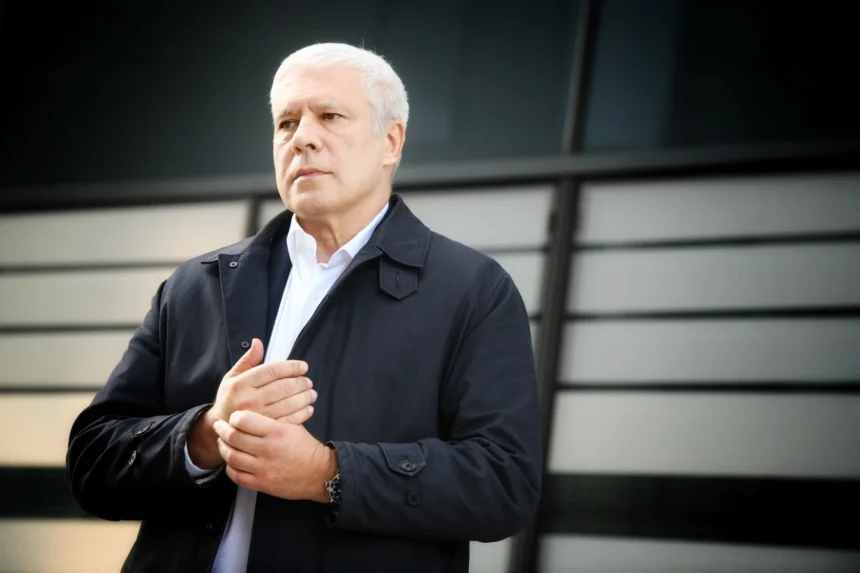
Former Serbian President Boris Tadić has sharply criticized the current Serbian government, claiming it was “formed in Moscow in consultation with Putin and Tomislav Nikolić, and aligned with Russian and German interests, not Serbia’s.” In an exclusive interview, Tadić described the regime as the only government in Serbian history fully established outside the country, and accused it of systematically destroying domestic political life.
Tadić said the current political crisis, including the handling of student protests and recent tragedies in Novi Sad, reflects the consequences of decades of opposition fragmentation and the deliberate weakening of institutions. “Stihijske reakcije i amaterizam koriste samo Vučićevom režimu,” he noted, emphasizing that spontaneous or disorganized opposition efforts only benefit Aleksandar Vučić’s administration.
The former president highlighted the regime’s repression, including pressure on universities, the judiciary, and media, as well as harassment of students and high schoolers. He argued that this turns youth into political actors prematurely, exposing them to the brutal nature of the regime while underscoring the opposition’s failure to unify.
Tadić also condemned the manipulation of elections. He explained that Vučić’s government strategically delays calling elections, waiting for moments that minimize political risk, and that past electoral losses by the opposition were often due to internal divisions rather than public support for Vučić.
Discussing the narrative of Serbian politics, Tadić described a “cult of personality” around Vučić, where propaganda dominates and public attention is diverted from substantive policy to spectacle and confusion. He stressed that this hybrid authoritarian model relies on fear, corruption, and control of information, leaving citizens dependent on propaganda for understanding political reality.
Reflecting on his own party, the Social Democratic Party (SDS), Tadić said it has been active in protests and civic actions despite media underrepresentation, and urged opposition forces to coordinate effectively. He emphasized that disunity in opposition ranks strengthens the regime, warning that every new division benefits Vučić.
On the formation of the SNS party, Tadić firmly denied allegations that the former DS had a role, asserting that it was the exclusive creation of Tomislav Nikolić. He also noted that many financiers of the DS shifted support to SNS after he restructured his party to eliminate corruption influence, arguing this contributed to the current political landscape.
Tadić concluded that Serbia faces a critical choice for its future. Victory over the regime requires preparation, strategy, and unified opposition, as elections alone are insufficient to dismantle a government that thrives on chaos and weak institutions.