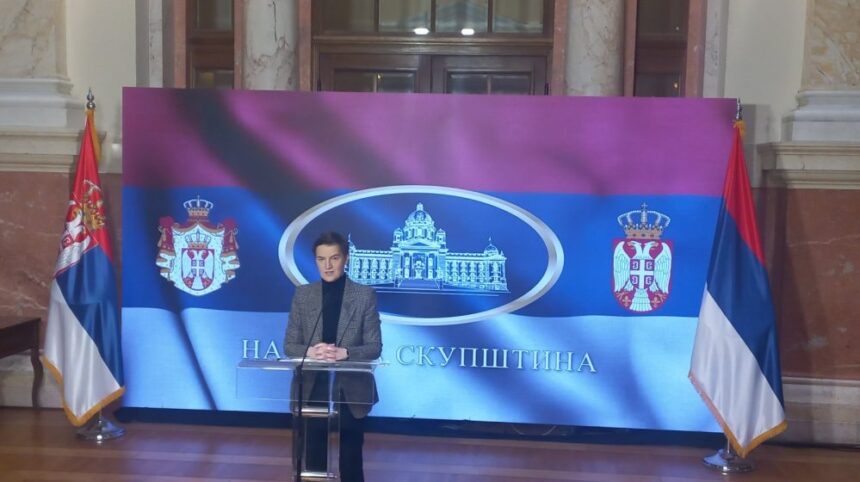
Serbia’s National Assembly Speaker and senior ruling Serbian Progressive Party (SNS) official Ana Brnabić responded on Thursday to accusations made by opposition politician Marinika Tepić, saying she is proud to be part of President Aleksandar Vučić’s political team.
Brnabić was reacting to claims by Marinika Tepić, vice president of the Freedom and Justice Party (SSP), who alleged that Brnabić is part of an organized criminal group allegedly led by President Aleksandar Vučić and his brother Andrej Vučić.
“I didn’t follow Marinika Tepić’s press conference — I don’t have that much time,” Brnabić told journalists at the Serbian parliament.
“I heard she mentioned me, and I thank her for that. I was already worried she hadn’t mentioned me yet. I’m sorry I was only fifth or sixth on the list. Thank you for including me in President Aleksandar Vučić’s team — I always like being on that team. That is a special honor for me,” Brnabić said sarcastically.
Reaction to RTS Editor Controversy
Asked about the reinstatement of Ivan Plavšić, an editor at Serbia’s public broadcaster RTS, after he allegedly insulted and threatened people gathered at a tent camp in front of the parliament, Brnabić said she was shocked.
“I can hardly recover from the shock that something like this is possible,” she said.
“I thought many things were possible, but to have an editor at the public broadcaster say such things and then be ordered to return to work — congratulations to those judges and everyone involved. It is a scandal of unprecedented proportions. It is also a scandal that he did not resign himself,” Brnabić added.
Opposition Accusations
Earlier on Thursday, Marinika Tepić presented what she called the fifth ‘ready indictment’ against an organized criminal group led by Aleksandar and Andrej Vučić, which this time focused on Ana Brnabić.
Tepić accused Brnabić of acting as “the political wing of the Vučić brothers’ organized criminal group”, alleging that during her terms as Prime Minister of Serbia (2017–2023) and later as Speaker of Parliament (2023–present), she “institutionally shielded a cartel network of power and normalized corruption as state policy.”
“Without her approval or signature, no key deal of this cartel could have been carried out,” Tepić claimed.