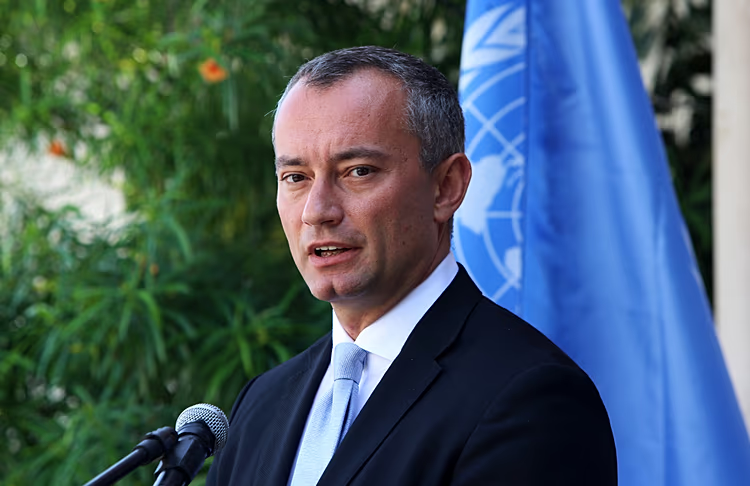
Bulgarian diplomat and former UN Middle East envoy Nickolay Mladenov has been selected to head a new international body overseeing the Gaza peace process, Israeli Prime Minister Benjamin Netanyahu announced on Thursday.
Netanyahu said Mladenov will serve as director-general of U.S. President Donald Trump’s “Board of Peace,” an initiative aimed at supervising the implementation of the second and more complex phase of the Gaza ceasefire. The announcement followed a meeting between Netanyahu and Mladenov in Jerusalem, during which the two were photographed shaking hands.
Key Role in Trump’s Middle East Peace Plan
In his statement, Netanyahu referred to Mladenov as the “designated” director-general of the board, which is expected to play a central role in overseeing post-war governance, security arrangements, and reconstruction in Gaza.
While there was no immediate official confirmation from Washington, a senior U.S. official, speaking anonymously, confirmed that Mladenov is the Trump administration’s choice to act as the board’s day-to-day administrator on the ground.
According to U.S. officials, President Trump is expected to formally announce the full membership of the Board of Peace later this month, with Mladenov serving as its chief executive representative in the region.
Mandate of the Board of Peace
Under Trump’s proposal, the board would be responsible for:
- Supervising a new technocratic Palestinian governing authority
- Overseeing the disarmament of Hamas
- Coordinating the deployment of an international security force
- Monitoring further Israeli military withdrawals
- Managing Gaza’s long-term reconstruction
The initiative represents a renewed attempt to advance a peace framework that has been largely stalled since an October ceasefire, which ended more than two years of intense conflict between Israel and Hamas.
Mladenov’s Diplomatic Background
Nickolay Mladenov previously served as Bulgaria’s defence and foreign minister and later as UN envoy to Iraq. From 2015 to 2020, he was the United Nations Special Coordinator for the Middle East Peace Process, during which time he frequently worked to de-escalate tensions between Israel and Hamas.
His appointment is widely viewed as an effort to inject experienced international diplomacy into an increasingly fragile peace process.
Ceasefire Under Strain
The first phase of the ceasefire, which began on 10 October 2025, halted large-scale fighting and led to hostage exchanges, with Hamas releasing Israeli captives in return for hundreds of Palestinian detainees held by Israel.
However, the truce has been marred by repeated accusations of violations. Hamas has yet to return the body of an Israeli police officer killed during the 7 October 2023 attack that triggered the war.
Meanwhile, continued Israeli strikes in Gaza have killed more than 400 Palestinians, according to local health authorities. Israel maintains that the strikes were responses to ceasefire breaches, while Palestinian officials report that many civilians have been among the casualties.
International Pressure Mounts
On Thursday, Egyptian and European Union leaders meeting in Cairo called for the deployment of an international stabilisation force in Gaza to help enforce the ceasefire.
EU foreign policy chief Kaja Kallas warned that the situation remains critical, stating that Hamas’ refusal to disarm and Israel’s restrictions on international NGOs are jointly undermining progress.
“There’s no justification for the humanitarian situation in Gaza to have deteriorated to the current level,” Kallas said.
UNRWA Warns of Humanitarian Collapse
Separately, UNRWA Commissioner-General Philippe Lazzarini warned that Israeli pressure on the UN agency for Palestinian refugees risks creating a “huge vacuum” in essential services.
Speaking in Ankara, Lazzarini said no other organization has the capacity or community trust to replace UNRWA’s role in healthcare, education, and social services in Gaza and the West Bank.
“If the agency is forced to stop operating, it will create a huge vacuum,” he warned.
Lazzarini was in Turkey to discuss ways to improve humanitarian access to Gaza, amid growing international concern over worsening conditions on the ground.