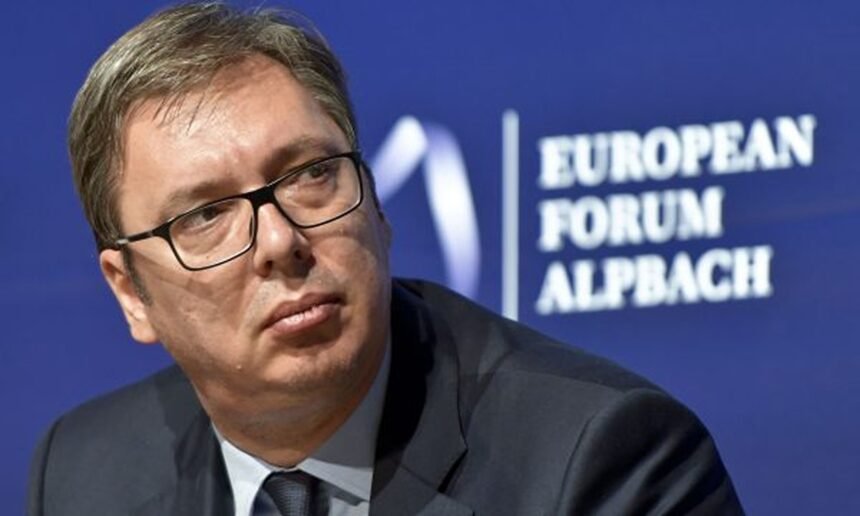
For years, the European Union viewed Serbian President Aleksandar Vučić as a key guarantor of stability in Serbia and the wider Western Balkans. However, amid deteriorating relations with Brussels, domestic political tensions, and shifting geopolitical dynamics, analysts are increasingly questioning whether he can maintain that role.
According to experts cited by Danas, the narrative portraying Vučić as a stabilizing figure has significantly weakened, largely due to foreign policy decisions that have distanced Belgrade from the European Union.
The “Stabilocracy” Narrative
Within EU political circles, Serbia under Vučić has often been viewed through the lens of “stabilocracy” — a model in which regional stability and political control are prioritized over democratic standards, rule of law, and media freedoms.
For Brussels, normalizing relations between Belgrade and Prishtina remains a central regional priority. Vučić’s strong domestic political position and electoral support have historically been seen as an advantage that could enable him to push through difficult or unpopular compromises required by the EU.
In addition, Vučić has long been perceived as a political actor with influence beyond Serbia, particularly in Bosnia and Herzegovina’s Republika Srpska and in Montenegro, making him a significant figure in regional politics.
Critics, however, argue that the EU has often prioritized stability over democracy by tolerating authoritarian tendencies in Serbia’s political system.
Growing Friction With Brussels
In recent years, relations between Serbia and the EU have become more strained. Several issues have contributed to this shift, including:
- Serbia’s refusal to impose sanctions on Russia
- The handling of the Banjska incident in northern Kosovo
- Increasing concerns over democratic backsliding
These tensions are reflected in European Commission progress reports on Serbia, which have shown a steady decline in ratings regarding democracy, rule of law, and media freedom.
Despite these concerns, the EU has repeatedly emphasized the importance of Serbia remaining on a pro-European path. After the fall of Miloš Vučević’s government, EU Enlargement Commissioner Marta Kos stressed that Brussels expects the next Serbian government to maintain the country’s European integration course.
Domestic Instability Weakens the Narrative
At the same time, internal developments in Serbia have further challenged Vučić’s image as a stability provider.
Mass protests and student demonstrations that erupted after the collapse of a railway station canopy in Novi Sad have sparked widespread public dissatisfaction and political unrest across the country.
Political analyst Miljan Mladenović argues that these developments have undermined Vučić’s central political message — stability.
“Since the Novi Sad tragedy and the continuous civic protests across the country, the narrative of stability has essentially disappeared,” Mladenović said.
Geopolitical Factors Could Still Play a Role
Despite these challenges, global developments could still affect how the EU perceives Serbia’s role in the region.
The escalating tensions in the Middle East, particularly involving Iran and Israel, have raised concerns about a potential new migration crisis in Europe. In such a scenario, Serbia could once again become a key transit country, potentially restoring its strategic importance for EU border security.
This dynamic raises the possibility that Brussels may again view Belgrade as an important partner in maintaining regional stability, similar to the role Serbia played during the 2015–2016 European migrant crisis.
Analysts: Vučić’s “Stability Factor” Status Is Fading
However, some analysts believe the era of Vučić as a stability guarantor may already be over.
Former Serbian diplomat Srećko Đukić argues that the idea of Vučić as a stabilizing force in the Western Balkans has long since passed — if it ever truly existed.
According to Đukić, Vučić still maintains a pro-European stance primarily for pragmatic reasons, particularly to preserve Serbia’s access to EU investment, markets, and development funds available to candidate countries.
“What interests him are the economic benefits of the European path, but without adopting European values,” Đukić said, adding that “even this double strategy may soon reach its limits.”
A Shifting Political Landscape
As Serbia faces growing domestic unrest, increasing scrutiny from Brussels, and rapidly evolving global geopolitical tensions, the question of whether Aleksandar Vučić can maintain his long-standing role as a ‘stability factor’ in the Western Balkans remains uncertain.