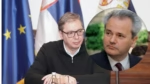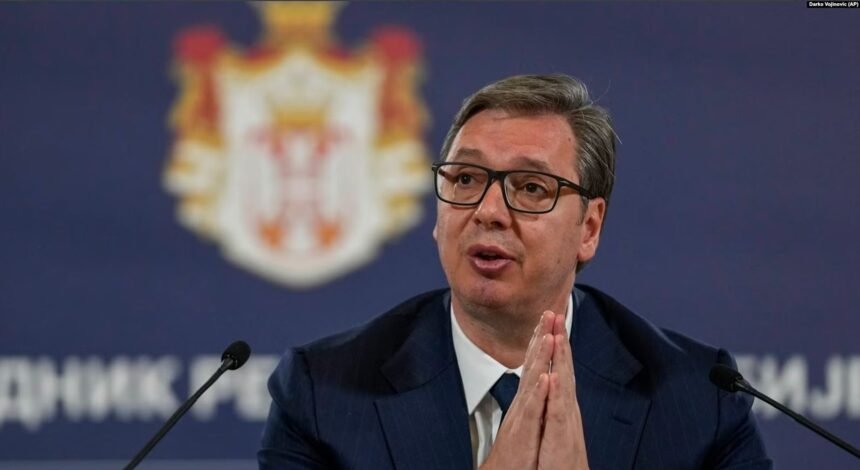
As Serbia approaches the end of President Aleksandar Vučić’s second and final constitutional term in 2027, a key question is resurfacing: Can Vučić be believed when he says he will withdraw from politics?
This question was formally posed by the Ecological Uprising, which insists that citizens deserve clarity about the future political landscape. But analysts warn: Vučić’s promises have often proven unreliable, and his repeated violations of the Constitution call into question any commitment he makes.
Opposition: Vučić Must Say Whether He Plans a Power Shift — Not a Departure
Aleksandar Jovanović Ćuta, leader of the Ecological Uprising, notes that Vučić constantly repeats that his mandate will soon expire and that he “cannot run again.” But, as Ćuta stresses, Vučić never says he will actually leave politics.
“We need to know if he plans to become prime minister — which he legally can — and continue ruling from another position,” Ćuta says.
“It’s important to know whether he intends to keep controlling and damaging this country.”
He warns that Serbia could face the same “power rotation games” seen in Montenegro (Đukanović) and Russia (Medvedev–Putin), where leadership changes were cosmetic but real power remained with the same individual.
Vučić’s Shifting Stories: A Pattern of Contradictions
Last year, during mass protests, Vučić claimed he had no intention to amend the Constitution to seek another term and that he would withdraw from politics entirely.
He even encouraged his successors to use his popularity for political advantage, offering them “human resources” like Ana Brnabić and Siniša Mali.
Yet today, the message is very different. Vučić now says only that he will “help” the ruling SNS and that his future role will be guided by what is “best for the country.”
Analysts: “Vučić Is a Reliable Source Only for Unreliable Information”
Political analyst Dragomir Anđelković is blunt:
“As our people say, ‘every time he opens his mouth, he lies.’”
He recalls that Vučić once swore he would never run for president and would instead support Tomislav Nikolić — only to reverse the decision almost overnight.
He also pledged unwavering loyalty to Kosovo, yet later made decisions critics equate with abandoning Serbia’s constitutional claims.
“In such circumstances, there is little meaning in asking Vučić anything or believing any of his promises,” Anđelković says.
Abandoning Constitutional Reform — Not Out of Principle, But Out of Weakness
Vučić has apparently abandoned plans to push for changes to the Constitution — not out of respect for democratic norms, but because he lacks the two-thirds majority required.
Just months earlier, he floated the idea directly, suggesting reforms to “solve internal problems” and hinting at broader political restructuring — which many interpreted as a potential attempt to extend his presidency.
Now that this is no longer feasible, analysts believe Vučić is preparing another move:
transitioning to the prime minister’s office after 2027.
Remaining Scenario: Control Through the Premiership
There is no legal restriction preventing Vučić from becoming prime minister after his presidential term ends.
And under Serbia’s Constitution, the prime minister holds more formal executive power than the president.
Observers note that Vučić, much like Slobodan Milošević, has reshaped political culture so deeply that the position he occupies becomes “the most important” simply because he occupies it.
Everything now depends on the outcome of the next parliamentary elections.
Conclusion: Vučić’s “Retirement” From Politics Is Highly Unlikely
Most analysts agree:
Vučić will wait for the elections, then choose the role that ensures he remains in control.
Despite his statements about not worrying about his personal future and being focused only on his “legacy,” there is still no clear or credible indication that he plans to withdraw from political life.