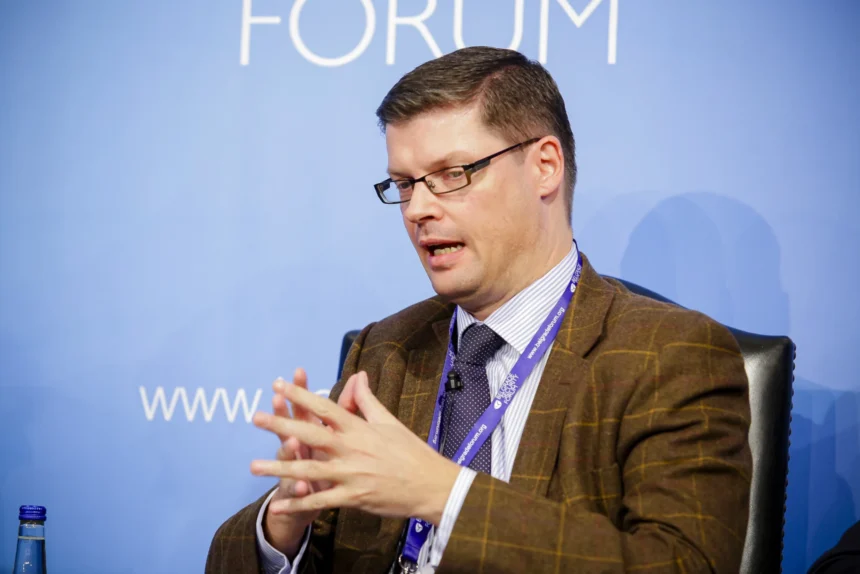
British academic and political analyst James Ker-Lindsey has stated that Europe is cautious about political change in Serbia, warning that the overthrow of President Aleksandar Vučić without a clear pro-European alternative could result in a pro-Russian government in the heart of the Balkans.
In an interview with Radar, Ker-Lindsey emphasized that student-led protests in Serbia have not demonstrated a clear and fundamental European orientation, which, he said, has contributed to the lack of strong political backing from the EU and the United States.
“The last thing Europe wants in the current geopolitical climate is for Vučić to fall and Serbia to end up with a pro-Russian government,” Ker-Lindsey said, adding that concerns over Russian influence remain a key factor shaping Western policy toward Serbia.
He acknowledged that European institutions are aware of authoritarian practices, including police repression, arrests of demonstrators, and pressure on the media, but stressed that geopolitical stability often outweighs democratic ideals, resulting in what critics describe as ‘stabilocracy’.
Ker-Lindsey also criticized the fragmentation and lack of vision within Serbia’s opposition, arguing that repeated calls for elections without clear, evidence-based policy platforms fail to resonate with voters. He noted that many citizens outside major cities believe their living standards have improved, complicating the political landscape.
On regional issues, he described Kosovo as a major unresolved failure of Western policy, stating that it has remained “trapped in limbo for nearly two decades”, with Serbia effectively held hostage by the unresolved status dispute. He warned that weak protection of the Serbian community in Kosovo undermines any chance of normalization and benefits Russian strategic interests.
Ker-Lindsey concluded that Serbia must decisively choose its European future, including deeper integration with the EU and eventually NATO, warning that continued ambiguity has led to a fundamental breakdown in trust between Serbia and its European partners.