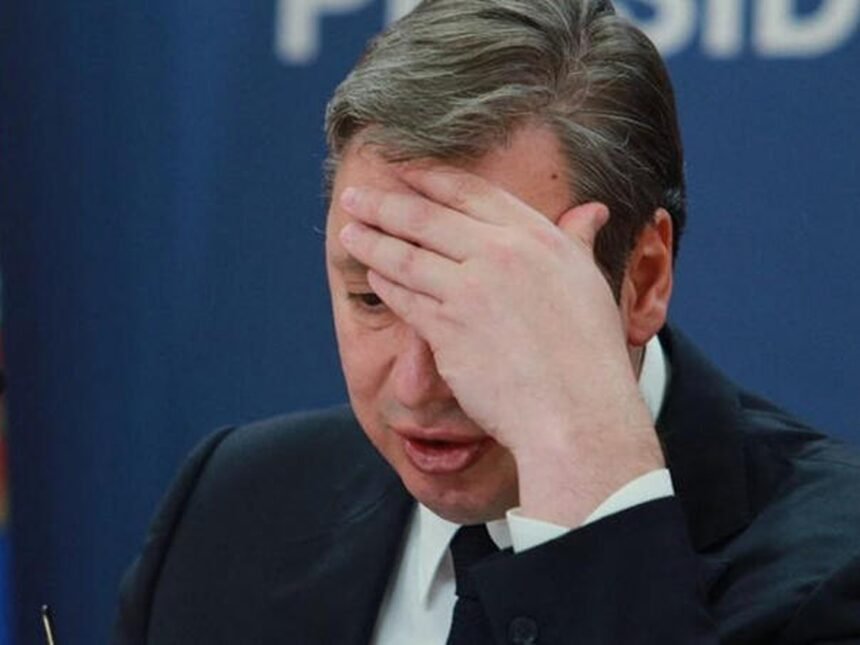
In an interview with the German newspaper Süddeutsche Zeitung, Aleksandar Vučić addressed Serbia’s relations with Russia, the United States, and the European Union, stressing that Serbia will defend its national interests and is “not anyone’s puppet.”
Energy crisis and sanctions on Serbia’s oil sector
Vučić said the country is facing growing challenges in energy supply, noting that oil and gas prices have surged dramatically in recent days.
“Everything is becoming more difficult,” Vučić said, pointing out that oil prices in Mediterranean markets have increased by about 15 percent in just two days, while gas prices are also rising sharply.
The Serbian president acknowledged that the situation worsened after U.S. sanctions targeted the Serbian energy company Naftna Industrija Srbije (NIS), which is majority-owned by the Russian energy giant Gazprom.
According to Vučić, these measures slowed Serbia’s economic growth, although he thanked the European Union and the team of Ursula von der Leyen for supporting plans to develop new gas pipelines and expand the country’s energy infrastructure by 2035.
Tensions with Moscow
Vučić also admitted that relations with Moscow have cooled in recent months. During negotiations over the ownership structure of NIS, he said Russia allegedly threatened to halt gas supplies, while Russian media outlets criticized him sharply.
“Traditionally we had good and friendly relations, but I had to protect Serbia’s national interests. We are not anyone’s puppets,” Vučić said.
Belgrade eventually agreed to a restructuring plan in which part of the company could be acquired by MOL Group and ADNOC, while Serbia would increase its ownership share from 29.87 percent to 34.87 percent, giving the government stronger oversight over financial decisions.
Serbian weapons and the war in Ukraine
In the interview, Vučić confirmed that some Serbian-made ammunition ended up in Ukraine through intermediary countries.
He said he openly discussed the issue with Vladimir Putin during a meeting in Beijing.
“I showed him the export list and asked: ‘Here is the list, what is the problem?’,” Vučić said, explaining that ammunition was exported to countries such as Czech Republic and the United Kingdom before eventually reaching Ukraine.
At the same time, he stressed that Serbia has not joined Western sanctions against Russia, claiming that the country has already paid a high economic price for maintaining its balanced position.
Criticism of U.S. policy on Kosovo
Vučić also criticized the current U.S. administration for what he described as a lack of stronger action toward the government in Kosovo.
He accused Prime Minister Albin Kurti of provoking the Serbian community in Kosovo and expressed disappointment with Washington’s response.
Vučić also referenced appearances by Kosovo’s president Vjosa Osmani in international forums, claiming Serbia did not expect such support for Pristina from the administration of Donald Trump.
A different vision for EU integration
When asked about Serbia’s prospects for joining the European Union, Vučić said full membership may not come soon.
He instead suggested a “multi-speed Europe” model, an idea he has discussed with Edi Rama. Under this concept, countries like Serbia could join the EU’s economic system and single market without full voting rights, veto power, or their own European commissioner.
“We believe in the single market and a Europe without borders. If we could become politically and economically part of the EU in that way, we would be very happy,” Vučić said.
Personal future after presidency
Asked about his political future after his second presidential mandate, Vučić said he does not plan to change Serbia’s constitution to remain in power.
Instead, he joked that he would like to advise his daughter if she starts a political consulting company in Serbia and possibly spend time coaching children’s basketball.