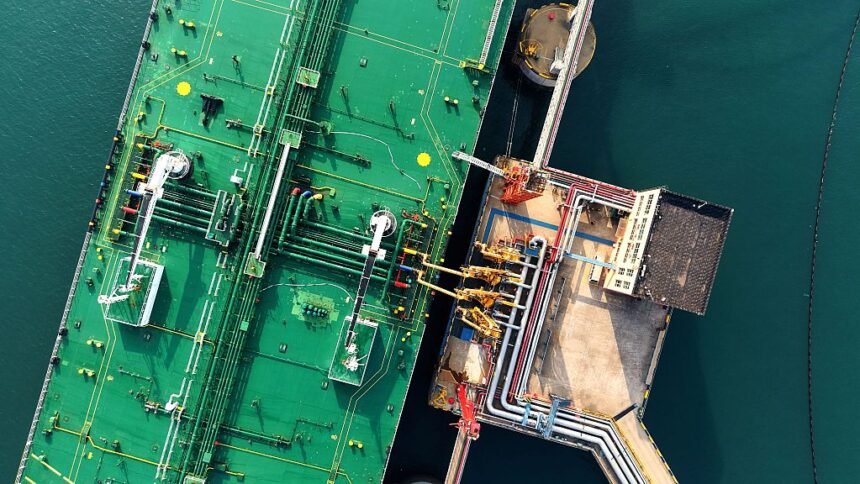
China continues to undermine international sanctions by purchasing vast quantities of Iranian oil, providing a crucial financial lifeline to Iran’s Islamic Revolutionary Guard Corps (IRGC), according to a Western intelligence agency speaking to Euractiv.
Oil sales—largely sustained by Chinese demand—remain the primary source of revenue for the IRGC, the dominant branch of Iran’s armed forces and the key actor behind the violent crackdown on Iranian protesters, the agency said.
“The primary buyer is China, accounting for roughly 90% of Iran’s oil exports,” the official stated, noting that Beijing shows little concern about the risk of secondary sanctions, driven by its need for cheap crude supplies.
Sanctions Evasion and Strategic Competition
Beijing is reportedly indifferent to Tehran’s domestic repression, with the official stating that China “simply doesn’t care about Iran’s domestic policies.”
To export oil, Iran relies on a shadow tanker fleet, similar to Russia’s, using disguised vessels that disable tracking systems. While Russia previously assisted Iran in sanctions evasion, the two countries are now competing to sell sanctioned oil to China, the intelligence assessment said.
Weapons Transfers and Missile Program Support
China’s support extends beyond oil purchases. Beijing does not pay exclusively in cash, the official noted:
“There are direct deliveries of weapons systems from China to the IRGC.”
Over the past six months, China has been the IRGC’s main backer in rebuilding Iran’s ballistic missile program, according to the assessment.
Additionally, Iran’s procurement operations are partly routed through Dubai, where a more permissive business environment facilitates transactions, the official said.
Funding Regional Proxy Forces
Despite Iran’s broader economy being described as “in free fall,” the regime continues to finance its regional proxy network, with Hezbollah in Lebanon identified as the main beneficiary.
“We estimate that Hezbollah received between $800 million and $1 billion from Iran last year,” the official said.
Regarding claims that Iran has used proxy militias to suppress domestic protests, intelligence officials urged caution. While there has been a limited influx of Iraqi Shia fighters linked to the Popular Mobilisation Forces (Hashd al-Shaabi), there is no evidence of large-scale deployment inside Iran.
The IRGC currently has sufficient manpower to suppress unrest internally, the official added, noting that Iraqi Shia militias are primarily used to advance Iranian influence within Iraq itself.
New Financial Channels: Crypto and Gold
Beyond oil, the IRGC is increasingly diversifying its funding sources, turning to cryptocurrency transactions and large-scale gold purchases.
Turkey has played a notable role in the gold trade and currency smuggling, the official said. Although the practice of transporting suitcases of cash via Turkish Airlines through Lebanon or directly to Tehran has declined, direct cash transfers from Turkey are still occurring.
These transfers have become more significant since Iran lost reliable land-based financial routes following the fall of its ally Bashar al-Assad in Syria in 2024, complicating direct fund movements.