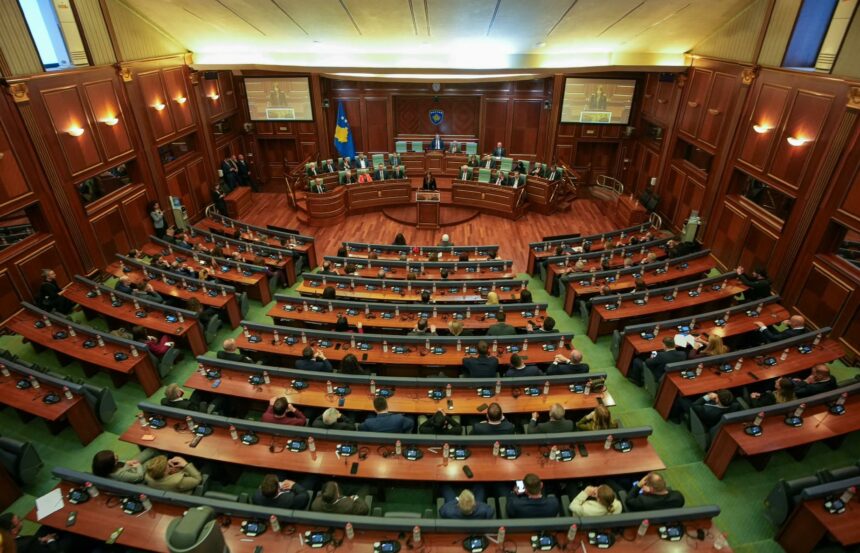
In a sensitive political moment, when Kosovo risked entering a new spiral of institutional uncertainty, the Constitutional Court of Kosovo issued a decision that restored formal constitutional balance—but not necessarily a political solution.
The annulment of the decree by Vjosa Osmani to dissolve the Assembly is seen by experts as a move that somewhat stabilizes institutions, while leaving the political crisis unresolved.
On March 25, the Court ruled that the president’s decree “has no legal effect” and gave the Assembly 34 days to elect a new president—otherwise, it will be dissolved.
Kosovo’s president is elected by the Assembly through three rounds of voting requiring quorum and a qualified majority, making the process heavily dependent on political compromise among parties.
Who benefits from the decision?
Osmani issued the decree on March 6, one day after the Assembly failed to elect a new president despite initiating the procedure.
The move was challenged in the Constitutional Court by Vetëvendosje, led by Prime Minister Albin Kurti.
As a result, the Court imposed a temporary measure suspending institutional actions until its final ruling, which was published on March 25.
According to analyst Vullnet Bugaqku, the Court used careful and balanced legal language, but did not avoid being influenced by the current political context.
“The constitutional and legal interpretation of this decree was made largely in the context of the current political deadlock,” Bugaqku said, noting this as one of the ruling’s weaknesses.
He added that the decision gives institutions another opportunity to fulfill their constitutional obligations—namely, to attempt once more to elect a president.
Neutral decision, but not purely professional?
Media analyst Rrahman Paçarizi offered a more critical view, describing the ruling as neutral, but not necessarily fully professional.
According to him, the Court went beyond a “strict legal interpretation” by taking political circumstances into account.
“It gave some advantages to some, less to others. But it was an attempt to ‘have it both ways’,” Paçarizi said.
No real winners?
Bugaqku argues that the main beneficiaries are the institutions themselves and the constitutional order.
“The real winners are the institutions—the Constitution and the Assembly. The Court restored the constitutional legitimacy of the Assembly’s mandate,” he said.
Paçarizi, however, notes a public perception that the decision favors Vetëvendosje, though he sees no concrete political gain beyond narrative-building.
“Reactions focused on the fall of the president’s decree, not on solving the crisis,” he said.
Toward early elections?
Despite its stabilizing institutional effect, analysts agree the decision has not produced a political solution.
“There is no real winner,” Paçarizi said, adding that the lack of political will for consensus makes it unlikely that the ruling will serve as a turning point.
He believes the country is heading toward early parliamentary elections, with parties likely to use the ruling as a campaign tool.
“It seems all political parties are comfortable going to elections,” he added.
Political reactions
Arbërie Nagavci from Vetëvendosje called for reflection and engagement to avoid another crisis.
Bedri Hamza stated he had not been invited by Prime Minister Kurti for discussions on electing a president.
Meanwhile, Lumir Abdixhiku emphasized that responsibility lies with the parliamentary majority, stressing that solutions require political agreement—not imposition.
The Alliance for the Future of Kosovo announced a meeting of its General Council to discuss the situation.
Following the ruling, Assembly Speaker Albulena Haxhiu has called a Presidency meeting for March 30.