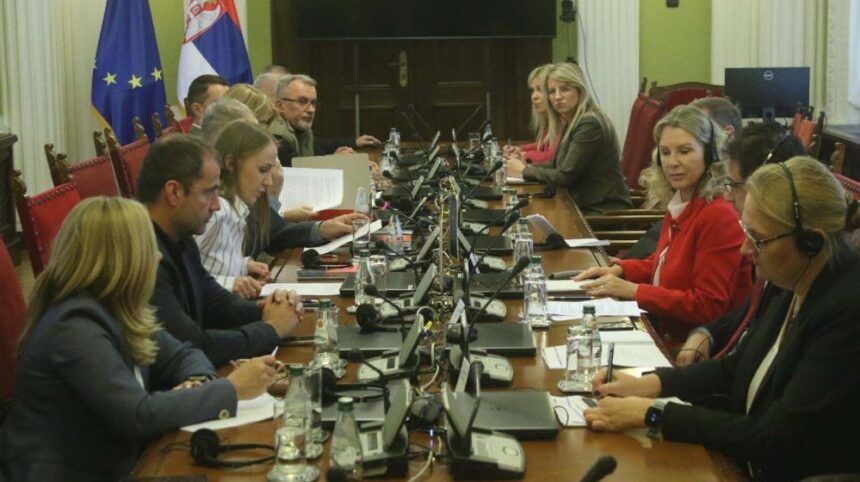
A delegation from the Monitoring Committee of the Parliamentary Assembly of the Council of Europe held a series of meetings in Serbia on Monday, engaging with both government representatives and opposition figures to assess the country’s political and democratic landscape.
The co-rapporteurs, Victoria Tiblom and Yunus Emre, met separately with members of the ruling coalition, opposition parties, and parliamentary committees.
Head of Serbia’s delegation to PACE, Biljana Pantić Pilja, emphasized the importance of the visit, expressing expectations that Serbia could move into a post-monitoring phase after nearly 15 years.
During discussions with the Committee on Constitutional and Legislative Affairs, chaired by Milica Nikolić, officials highlighted efforts to improve the electoral process, including public hearings on amendments to the voter registry law.
Government: Claims of Pressure and Commitment to Dialogue
Representatives of the ruling coalition stated they are open to dialogue and cooperation with European institutions. They also claimed that government officials have faced various forms of violence, while stressing the need for a full investigation into the deadly Novi Sad railway station canopy collapse.
The rapporteurs showed particular interest in judicial reforms, anti-corruption investigations, and the functioning of institutions such as the prosecutor’s office for organized crime and war crimes.
Opposition: Concerns Over Democracy and Elections
Opposition representatives, including Borko Stefanović, raised serious concerns about democratic standards in Serbia. They pointed to alleged irregularities in the electoral process, including outdated voter lists, police presence at polling stations, and organized voting by foreign citizens.
Opposition MPs also highlighted issues related to media freedom, rule of law, and what they described as increasing police repression against protesters and students.
They welcomed the decision of the Council of Europe to send an observation mission for the upcoming local elections, arguing it would provide an independent assessment of electoral conditions.
Diverging Narratives
While the government stressed institutional reforms and cooperation, opposition figures argued that democratic space in Serbia is shrinking and that key democratic mechanisms are being undermined.
The delegation also met with Parliament Speaker Ana Brnabić as part of its broader fact-finding mission.
The visit comes at a critical time as Serbia faces growing scrutiny over its democratic standards and progress toward European integration.