Former paramilitary members, ultra-right extremists, convicted criminals, and even released murderers are operating openly among supporters of Serbia’s ruling party, raising serious concerns about the safety of citizens and the consolidation of authoritarian power.
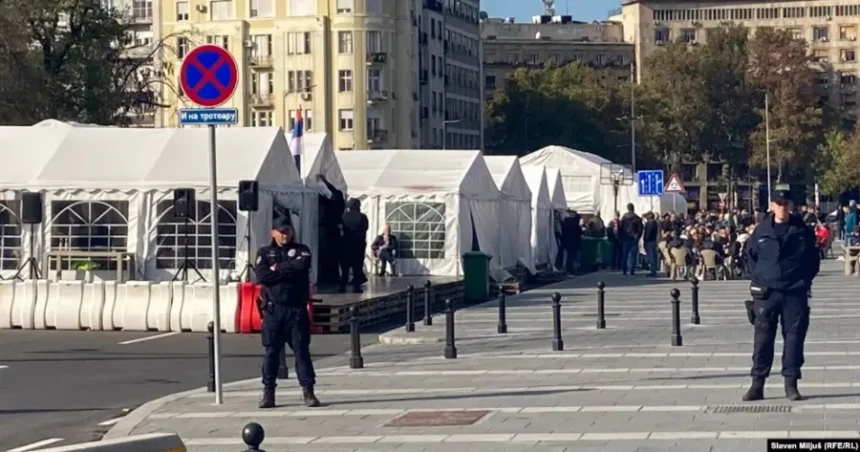
At the center of this phenomenon is Ćaćilend, a tent camp established between the Presidency and the National Assembly in Belgrade. Ostensibly a political gathering space, sources describe it as a paramilitary and quasi-police enclave, where individuals with violent criminal histories are deployed to protect party assets and intimidate protesters.
“Citizens are only safe if they avoid this camp entirely,” said Predrag Petrović, director of research at the Belgrade Center for Security Policy. “Ćaćilend operates outside normal legal frameworks and has become a tool for maintaining Vučić’s grip on power.”
Vučić Celebrates the Camp as a Symbol of Resistance
President Aleksandar Vučić has publicly praised Ćaćilend, framing it as a “symbol of Serbia’s freedom and resistance.” Experts argue this is an implicit acknowledgment that extra-institutional force is central to the regime’s survival.
“The camp is not just a political statement; it is a militarized apparatus that shields Vučić from popular mobilization,” Petrović added.
By keeping the camp operational, Vučić effectively suspends the rule of law in a central part of Belgrade, creating a “black box” where normal legal protections do not apply, while normal citizens pass daily by tents, barricades, and armed enforcers.
Criminal Elements in the Heart of Power
RFE/RL reporting has identified several individuals with serious criminal records operating within Ćaćilend:
- Vladan Sretenović: Formerly imprisoned for a 1997 murder, recently extradited from Croatia after fleeing a 1.5-year sentence for assault.
- Giorgie Prelić: Convicted of murdering a French football fan in 2009, conditionally released in 2021.
- Jovan Coja Kecman: Convicted of attempted murder and illegal arms possession, now active in a local boxing club.
- Vladimir Vuçetiq: Accused by the Kosovo Special Prosecution of participating in a 2023 deadly attack on Kosovo police; currently at large.
- Former Red Berets members, including Goran Radosavljević and Zhivorad Ivanović, veterans of units implicated in war crimes and political assassinations under Slobodan Milošević.
- Dragoslav Bokan: Founder of the paramilitary group “White Eagles,” previously prosecuted for weapons violations and robbery.
These figures, many convicted of violent crimes, now operate openly under the protection of state authorities, blurring the line between government and organized crime.
Government Officials Complicit
Vučić’s inner circle and local SNS officials have been photographed side by side with armed paramilitaries at Ćaćilend. Vladimir Mandić, an SNS official and former handball player, was captured on video violently assaulting a student protester and allegedly attacking journalists, demonstrating the normalization of political violence.
Protests Met with Violence and Intimidation
Protests against government corruption, negligence, and demanding early elections have been ongoing for over a year. Demonstrators have faced systematic violence, arrests, and intimidation, while Vučić portrays the criminalized camp as a patriotic stronghold, legitimizing extra-legal measures against citizens.
Experts warn that Ćaćilend is not merely symbolic: it is a strategic instrument enabling the regime to project power, suppress dissent, and intimidate the population, undermining the democratic framework of Serbia.
“The camp represents the entrenchment of authoritarianism,” Petrović said. “Vučić is effectively governing through a militarized proxy network, rather than institutions accountable to the law.”
Ćaćilend, once dismissed as a bizarre protest encampment, has become a central pillar of the regime, symbolizing the fusion of political power, criminal networks, and paramilitary force in modern Serbia.