Croatian investigative journalist Domagoj Margetic has released documents allegedly proving that Serbian President Aleksandar Vučić participated in the so-called “Sarajevo safari,” where foreign visitors paid to shoot civilians during the siege of Sarajevo.
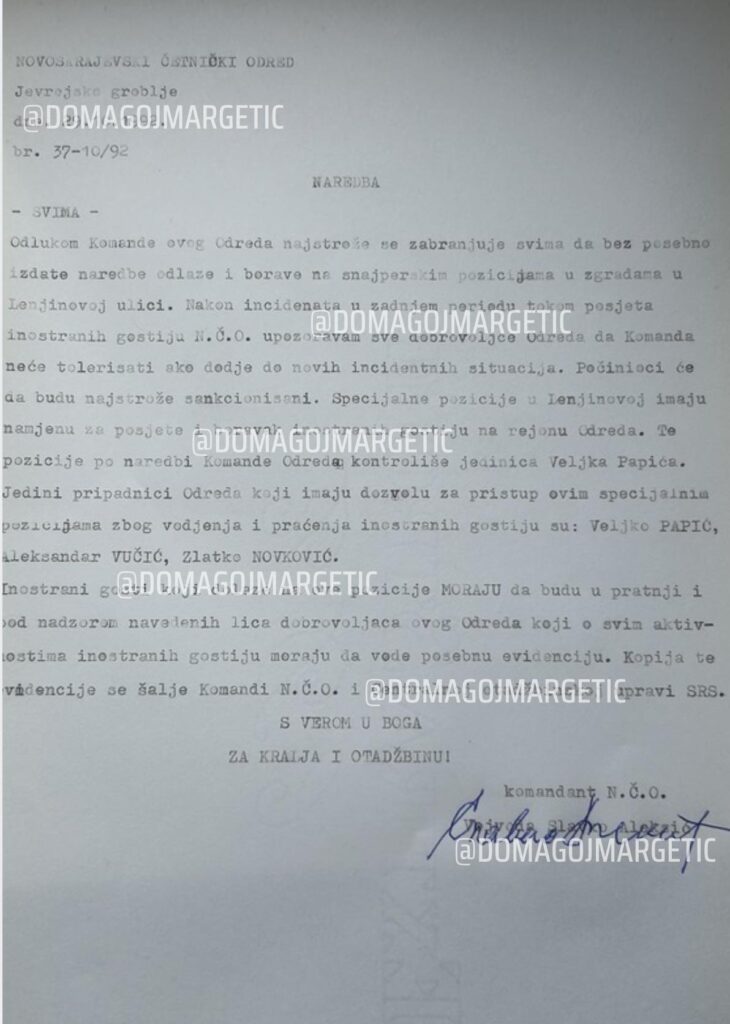
Among the documents, one dated 29 October 1992, numbered 37-10/92, stands out as the first and only known record explicitly mentioning sniper positions reserved for foreign guests. According to Margetic, the content leaves no doubt that Vučić was part of the organization facilitating these “human safaris.”
The document reportedly details logistical arrangements for foreign shooters, including sniper positions and support by local militia, implicating Vučić in coordinating and escorting foreign participants during some of the city’s deadliest periods.
Margetic claims that these revelations directly link Vučić to war-time atrocities, contradicting the Serbian president’s long-standing denials that he had any operational role in Sarajevo beyond his work as a journalist at the time. Vučić’s office has dismissed previous allegations as “malicious disinformation” designed to undermine his credibility.
According to Margetic, the investigation draws on Aleksic militia archives, eyewitness testimony, and corroborating materials that suggest a broader network of foreign and local snipers exploited Sarajevo for profit and sadistic entertainment.
“This document is significant because it names both Vučić and the sniper positions intended for foreign guests,” Margetic said. “It provides tangible evidence that foreign snipers were being hosted and that Vučić had a role in their coordination.”
If verified, the findings raise serious questions about foreign complicity in war crimes and the involvement of individuals who later rose to positions of political power. Legal authorities in Italy have already begun investigating alleged Italian participants in the sniper tours.
Margetic’s revelations add to a growing body of evidence suggesting that Sarajevo was not only a site of siege but also of orchestrated exploitation by foreign and local actors, with long-term implications for historical accountability and international justice.